As our trailer is our new home, each RV park is a new neighborhood. We are going to be visiting a total of 18 of them on our trip, so we clearly need to get comfortable with the wide diversity of places we are going to be living in – and letting the last one go as we embrace the next one. Some of the neighborhoods will feel like old friends, since we have stayed in them before. But most of them are unknown to us.
We left Albuquerque, a metro area of 915,000 population and traveled 3 hours to Ruidoso NM, a small resort town of 20,000 metro population. The contrast was dramatic on many fronts. Our place in Albuquerque was in on the edge of vast desert plain with rock mesas in the background. Ruidoso is in the hills surrounded by red pines. Our new RV park has 25 pretty cramped spots on gravel (provoking modest cursing on the back in parking!) whereas our previous park had 225 very spacious lots on concrete, with no one within 40-50 feet of us. In addition to the sights, the sounds, smells and feel of the place are different – all adding up to a very different “vibe”. As we keep moving, understanding what makes for a neighborhood “vibe” is one of the tasks we have set for ourselves.
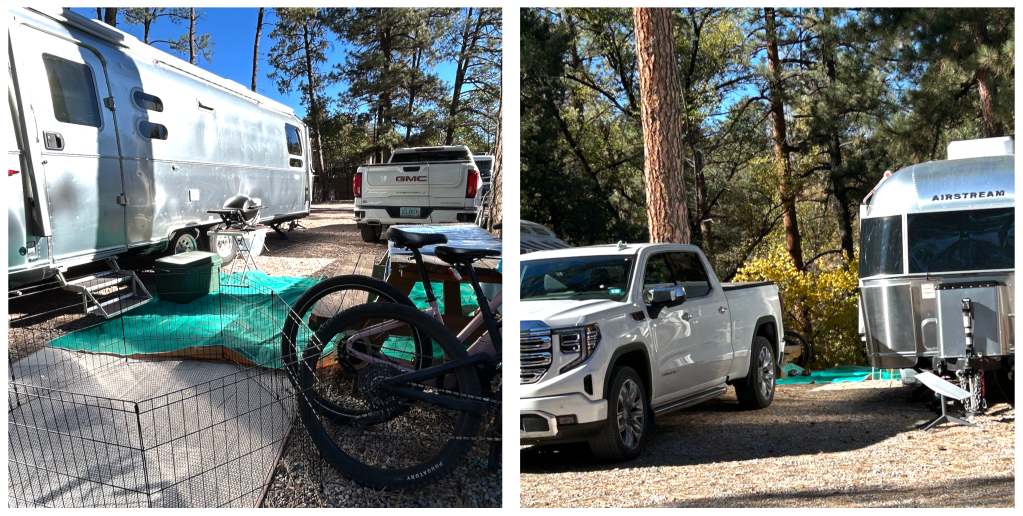
Our New Home in Ruidoso
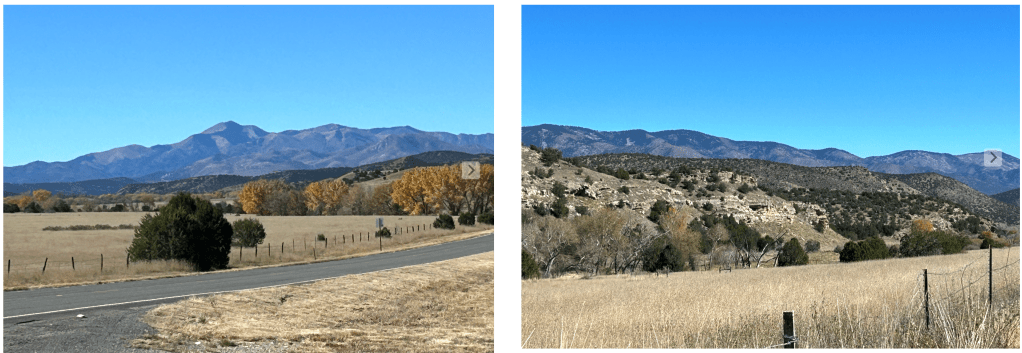
Some Ruidoso Mountains
Another distinguishing feature of Ruidoso is its unfortunate history of encounters with natural disasters. We didn’t understand this before we came, but over the past two decades this little mountain town has been hammered by fire and flood. In 2012, a fire burned 44,000 acres in surrounding areas, destroying 242 homes. It was one of New Mexico’s most destructive fires at the time. A decade later in 2022 another fire ignited, right on the edge of town. It burned over 6,000 acres and destroyed 207 homes, killing two residents as high winds drove flames straight into neighborhoods. Finally, in June of 2024, the South Fork and Salt Fires swept through the region, together burning roughly 24,700–25,000 acres and damaging or destroying an estimated 1,400 structures, including homes and businesses, and killing two people. These overlapping fires stripped hillsides of trees and ground cover, setting the stage for catastrophic flooding.
Flooding has hit Ruidoso hard more than once. In July 2008, moisture from Hurricane Dolly dropped up to 9 inches of rain over a few days. The Rio Ruidoso jumped from about 4 feet to 12 feet, destroying a dozen bridges, flooding roughly 60 homes, and damaging hundreds of other structures and campers. After the 2024 wildfires, in July of 2025, about 3.5 inches of rain fell in roughly 90 minutes on the 2024 burn scars. The Rio Ruidoso surged to a record crest of around 20 feet, overtopping banks and sweeping away 150–200 homes.
Signs of the fire and flood damage are still all around us. Our RV park looks over the river that flooded in 2024, and if you walk 100 yards down to it, you can see damaged and destroyed homes all along the river. The sound of excavators is a daily experience. When you hike in the mountains, you don’t have to go far before you get to burned slopes. So, Ruidoso’s “vibe” right now is not just its scenery and tourism, but a town living with the multiple impacts of extreme rain and wildfire—rebuilding homes, hardening infrastructure, and trying to protect a place they refuse to give up on.
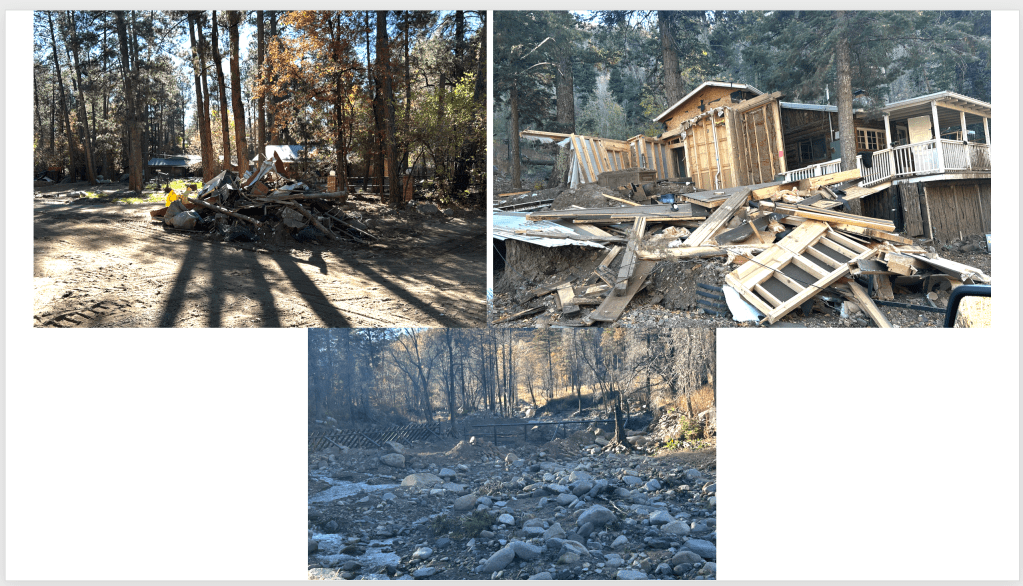
Remnants of the 2025 Floods
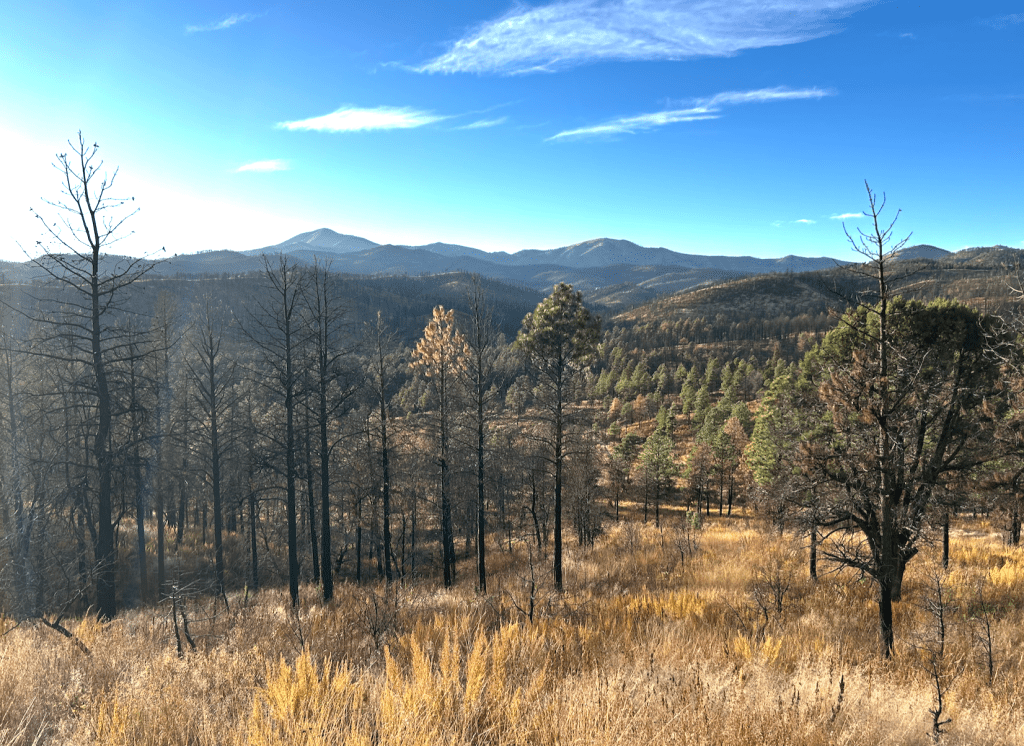
Despite the Charred Trees, the View is Still Awesome
The history of Ruidoso makes us very thankful for the historical security and safety of our home in Tamworth NH. In the many generations that our family has been connected to that place, we never experienced a fire or a flood. However, this summer, New Hampshire had the lowest summer rainfall ever recorded. This was the first summer we felt nervous about forest fires and looked cautiously at the trees around our house wondering if we should thin them more.. The normally damp forest behind our house became bone dry and smelled like the arid pine forests out here.
Despite its history with tragedy, we still had a lot of fun exploring the Ruidoso countryside. The pups were delighted when we found some gentle 2-3 mile hiking/biking paths with great views that have become a daily adventure.

The Pups on a Mountain Walk; and Begging for Breakfast Toast Crust!
We are headed to our next neighborhood in Las Cruces tomorrow. It will again, be very different. Located near the White Sands National Park, it is New Mexico’s second largest city, on flat high desert surrounded by tall peaks.
On to the next Grand Adventure!
Two Airstream Mishap Footnotes — And Lessons Learned
When you are hauling your home behind you, it is always possible for mishaps to occur. We dodged two Airstream mishaps between Albuquerque and here. When we set up at the Albuquerque site, we noticed an odd squeak when we walked through the trailer. I had Michelle walk around while I crawled under the trailer to figure out what was going on. It turnout out that one of the nuts holding a rear shock absorber had loosened and fallen off. Fortunately, the shaft was still in the shock absorber holder. It is hard to imagine what bad things could have happened if it disconnected at 65 mph! I first tried the DIY approach and bought a replacement nut, but it wouldn’t go on because of wear on the shaft thread. We ended up having the trailer spend a day at the local Airstream dealer. Needless to say, I now check the shock nuts regularly!
The second near mishap happened on the way from Albuquerque to Ruidoso. We were traveling on a very smooth highway, going downhill, and I was not properly paying attention to the speed. (A virtue of our truck/trailer match is that it is easy to forget we are hauling a 26’ trailer – but that can be a downside also.) Michelle, (who watches my speed closely!) noted that I was going 78 mph instead of my standard 65 mph. (The speed limit is 75 mph.) At just that time, we hit a slight bump in the tarmac and the trailer started swaying back and forth wildly. It was truly terrifying. We were immediately in emergency mode. I put on the emergency blinkers and start to slow the rig down to get it under control. I pulled over to the breakdown lane as soon as possible. I was sure something had happened to the hitch connection. Not so. Everything was fine. The problem was my speed – with the trailer load on the truck, even when it is level with the sway bars, there is still less weight on the front tires. When I returned to 65 mph, the rig hauled just like it was supposed to. Lesson learned – don’t speed and pay attention all the time! (When we get to Phoenix, we are getting some additional trailer air shocks installed to fix the overall problem. Regardless, the lesson is still the same – don’t exceed 65 mph!)
 John and Michelle's Grand Adventure
You must be logged in to post a comment.