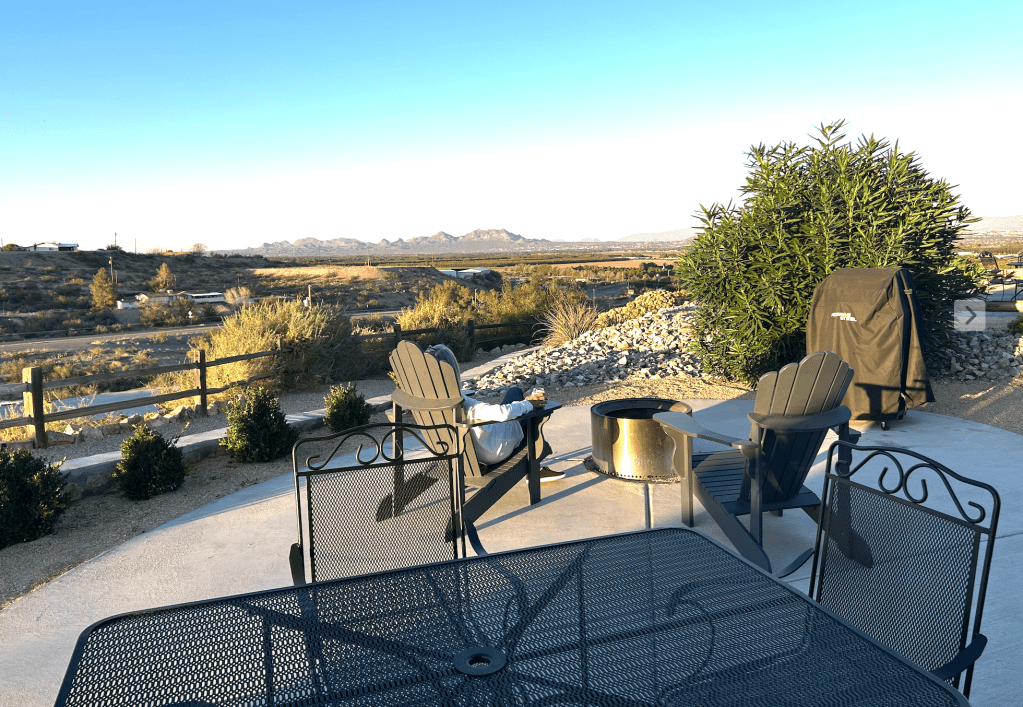
Our New Neighborhood — Las Cruces KOA

Making Friends on the Road
If the trailer is your home and RV parks are your neighborhoods, then the next circle of social intimacy is your neighbors – who do you interact with and get energized by? On the road, the RV park is a natural “bump factor” environment. It is easy to meet your neighbors, since you are so close together. Connections get made in many ways – similar trailers; license plates from nearby states; dogs that meet each other and talk to each other; a friendly glance, etc. Every once in a while, your strike up a relationship that is special. This happened to us in both Albuquerque and Ruidoso.
It is interesting how quickly you can figure out if you are interested in going beyond pleasantries with someone. It has to do with the sound of their voice, their body language and just the overall “gestalt” of their presence – especially the look in their eyes. You can tell if a stranger “sees” you – a crinkle in their eyes, a full smile, a twinkle.
In Ruidoso we first met Chris and Jill through our dogs – they had a female schnauzer that our dogs liked a lot. And then there is the fact that they had an Airstream trailer the same size as ours (although a different model). It only took a couple of transactions (Where did you come from? How long are you here? How do you like your trailer?) before we figured out there was a great chemistry going on.
Chris and Jill are in their late forty’s. They have five kids, all of whom are out of the house in one way or another. They realized they had a window of 5-7 years between now and grandkids or taking care of parents, during which they could be gone for long periods of time. So they sold their house and bought a 27’ Airstream Globetrotter and hit the road, planning on traveling for several years. Their style of planning couldn’t be different than ours. Whereas we have a spreadsheet with every RV park for seven months all laid out with pre-paid reservations, (Oh, yes, obsessive behavior!) they call for reservations on the day they are driving, never really knowing where they will end up. We always get full-service sites (electric, water, sewer) and they are happy “boondocking” with no services for days at a time if needed.
It was delightful how quickly we connected, and how much intimate detail we shared with each other in a very short period of time. We had wine and hors d’oeuvres in their trailer and they visited ours. We talked about our kids and (in our case) about our grandkids; our professions; our ancestors, our homes; our hobbies, our food, our travel – pretty much anything you can think about. We laughed when we engaged in the “trailer inspection” ritual, whereby folks who own similar trailers feel free to pull out drawers, check closets, look in showers and bathrooms, inspect bedrooms, turn on and off lights – all in the pursuit of useful comparison between small and mobile living environments.
Another connection experience happened in Albuquerque with a gal named Shirley. Walking our dogs around the park we always passed the dog run. On one pass Shirley peaked above her sunhat and made that telling eye contact. That led right away to hellos and introductions. She has a rescue pup named Josie. She and her significant other travel most of the year, in their “diesel pusher”, rotating between southern and more northern locations. As they often do, the dog run provoked a new and surprisingly immediate connection.
In both cases, in three days we made new friends. And one day later, we parted company, pretty certain we would never see (or even connect with) each other again. This is the bittersweet nature of friendships made on the road. They glow when they are in full swing, and fade like a firefly’s light when you both move on. Like the shifting landscape of neighborhoods, you must treasure them and then let them go. They are a delight not to be missed, and we feel blessed when they happen.
Magical White Sands
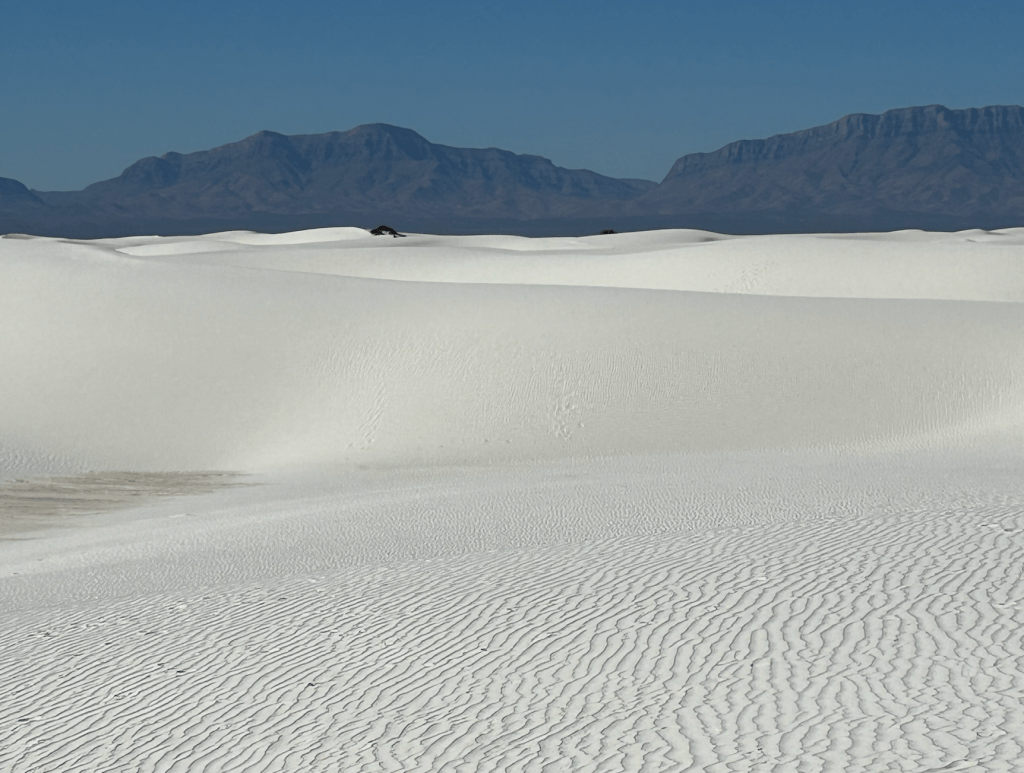
The White Sands National Park is about an hour from our RV site in Las Cruces. It is truly one of the most amazing places we have visited, right up there with the Utah parks of the Arches and Bryce Canyon. The park covers 227 square miles and has a field of white sand dunes made of gypsum crystals. It is the largest of its kind on Earth. From the National Park Service and other sources, we harvested these tidbits about the park:
- The gypsum dunes evolved over hundreds of millions of years. Around 250 million years ago, the area was covered by a shallow sea that deposited thick layers of gypsum and other evaporite minerals as the water evaporated. About 70 million years ago, tectonic forces uplifted the surrounding mountain ranges — the San Andres and Sacramento Mountains — and created the down-dropped Tularosa Basin, a closed basin with no outlet for water.
- During the last Ice Age, roughly 20,000 years ago, meltwater from glaciers and rainfall dissolved gypsum from the surrounding mountains and carried it into the basin’s lowlands. This water collected in a large ephemeral lake, Lake Otero, which gradually evaporated as the climate warmed. The gypsum crystallized as selenite, which later broke down into fine sand-sized grains.
- Persistent winds sculpted the gypsum deposits into dazzling white dunes that now cover the 227 square miles. Unlike typical quartz sand, the gypsum does not absorb heat, giving the dunes their cool, bright white appearance even under intense desert sun.
- Today, the landscape is still evolving — dunes migrate, new ones form, and shallow flats and lakes appear after rain, continuing the geologic cycle that began millions of years ago. Lake Lucero forms each year in the rainy period and then dries up. During the rest of the year, while it looks like a desert, ground water is still only a few inches underground. As one NPS brochure put it, it is “the wettest desert around.” As a result, compared to others, gypsum dunes remain moist during the longest droughts. The moisture is what prevents the dunes from blowing away.
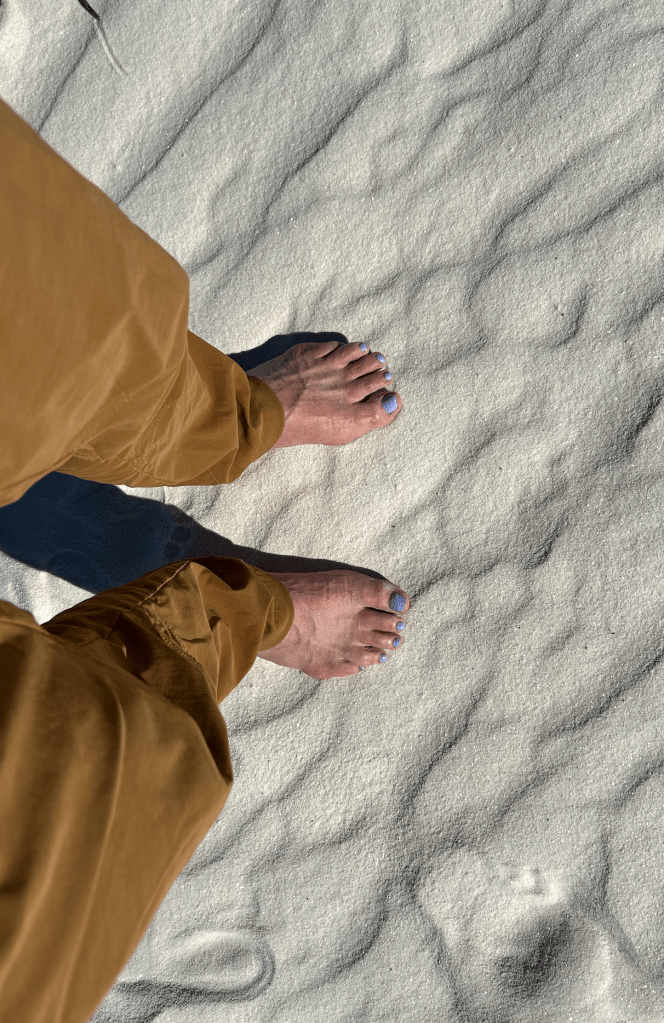
I took a 5-mile hike through the dunes. The whole walk felt ethereal. It was a good thing that I had sunglasses because the sand was blindingly white. It was firm from the wind, so you weren’t slogging through it. About halfway through the hike I realized many of the footprints I was following were from bare feet. So I decided to try it out and it was awesome. Because the sand does not absorb heat, it was cool to the touch. The granularity was consistent across the entire landscape – no pebbles, sharp rocks, stick or any other obstructions for the entire hike. The feel of the cool sand on the soles of my feet was immensely pleasurable. It felt like a walking foot massage. I wandered a lot off trail, following the dune topography. I felt like I could hike forever.
Fortunately, I didn’t and got home at a reasonable hour instead. The next day, I was talking to a local and he told me that the best time to be in the dunes is during full moons. The moonlight on the crystals makes it shimmer like magic. Since the park is opened at night, groups congregate especially during “blue moons” to enjoy this wonder of our vast land.
Next stop – Arizona!

An Expanded View of the Crystal Sand

Looks Like Snow to Me!


Barefoot Is The Way to Go!

These Prints Won’t Last Long
 John and Michelle's Grand Adventure
You must be logged in to post a comment.