After the two idyllic weeks of scenery, weather, and adventures in Avila Beach, you knew all that would need to be followed by some kind of karmic balancing. Sure enough, it showed up right on schedule.
Karmic Balancer #1 — Power Crisis
[GEEK WARNING – this section is full of all kinds of details on trailer operations that could prove totally boring to non-trailer users. Feel free to jump to the next section!]
Our reservation at Avila Bay ended on a Saturday. We moved to an RV park 10 miles south so we could continue to enjoy the area. The RV park was not nearly as nice, but our trailer was just a 2-minute walk to a vast and wonderous beach (Pismo Beach), so we looked forward to enjoying it, nonetheless.
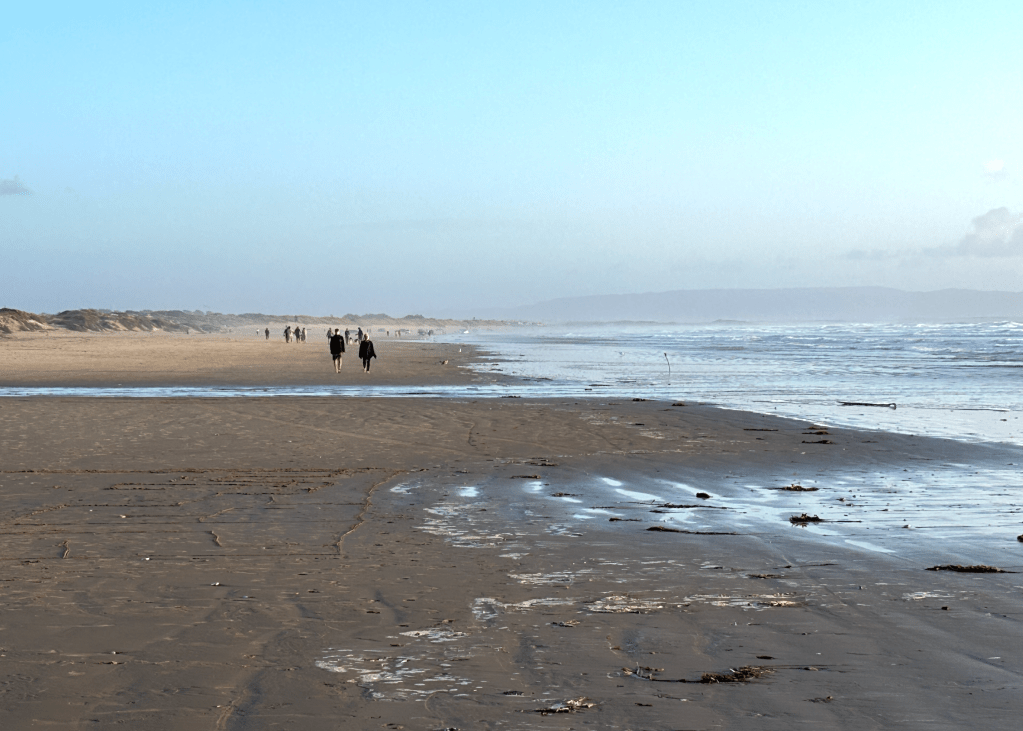
Pismo Beach
On Saturday night after our move, we were lying in bed watching the Olympics. I had a glass of water on the surface next to my bed, which I promptly knocked over, dumping it on our mattress and the floor. After a flurry of cursing, we got it cleaned up and figured that was the extent of the damage. Unfortunately, not so. Shortly after the water spillage, we began hearing a strange humming sound in the bedroom. We couldn’t figure out where it was coming from. (For a moment, we unfairly blamed it on a neighbor running a portable generator.)
It turned out to be coming from the trailer “inverter” under our bed. Not much later, we detected that unpleasant odor you get from heated electrical circuits – not good! Michelle Googled “I dumped water on my inverter. What do I do?” and it shot back: “Disconnect all power from the trailer, immediately!” It was clear that the water had ended up on the inverter and shorted it out, cutting all power off to the trailer.
But what the hell is the inverter exactly? I really had no idea. It turns out it has two functions (explained care of ChatGPT, of course):
- Make household electricity from the batteries. The trailer batteries store DC (12 volt) power. If we’re not connected to our main electricity source (what they call “shore power”) and want to use our batteries as a power source instead, the inverter converts the DC power into AC power (120 volts) to be able to run things like the TV, outlets, device chargers, etc.
- Pass power from your connecting cables through to the rest of the trailer. When we plug into the 50-amp electricity cable, the inverter detects shore power, stops inverting (since you no longer need the batteries as a power source), switches into “pass-through mode” and allows AC power to flow through it to the trailer. It also becomes a battery charger and recharges your batteries. If the inverter doesn’t work, no shore power gets to the trailer.
Because we had no idea what to do, we disconnected the 50-amp power cord coming into the trailer and turned off the battery power. As a result, on Saturday night we found ourselves in a trailer, completely without power – no lights, no plugs to power devices (which meant no morning coffee!), no Internet, no heat, no hot water, no microwave, nor refrigeration – and little hope of getting the problem solved on a Sunday when every repair service would be closed. The gas stove still worked, as did our water and septic, since neither depended on electricity. We had no idea what to do next, we just went to bed – in a funk to be sure.
(OK, we need a nod to our dry camping/boondocking friends who happily live for several days while voluntarily foregoing any electrical power (except batteries), water or septic services. Of course, they prepare for this with appropriate technology (like extra batteries and more solar power) and behavioral routines (like extreme water conservation), none of which we have done. We confess, we are wimps!)
It was six days before we got our power back. It involved parallel paths of: 1) securing an inverter replacement and 2) engineering workarounds to re-secure the conveniences and comforts we had lost while we waited for the repair.
The repair path went something like this.
First call to the mobile RV repair on Sunday: “We can’t get a technician to visit you until Wednesday.” “No – that is way too late! We leave on Friday!” “OK, our manager Scott can come at 9 am on Monday.” “Excellent!”
Call from Mobile RV repair at 8:30 am on Monday: “Scott can’t come because he had a knee injury and is in the hospital for surgery.” “Oh shit! OK, we’ll try a local RV dealer instead.”
Monday am call to the RV dealer down the street: “We can send Tom over at 10 am.” “Excellent!” (Tom comes and confirms the inverter is toast and needs to be replaced.)
Monday pm visit to the RV dealer service manager (really nice guy also named Tom): “We can get an inverter here by Wednesday and install it that day. If you don’t hear from us by 1:00, give a call.” “Excellent!”
Wednesday pm visit to Tom after they don’t show up: “Turns out the inverter won’t be here until Thursday. Can you bring the Airstream over here at 9:00 am to do the install?” “Hmm. OK, I guess that would work.”
Thursday am call from Tom: “The inverter is here but our schedule is jammed. We can’t do it today. Can you come tomorrow (Friday) at 9 am?” “Yikes! Yes, but we must have it done that day because we leave Friday for a place five hours north!”
Final Friday 2 pm call from Tom: “Trailer is done. Inverter installed and working. You can pick it up.” “Phew! Excellent!”
Friday 2:30 pm visit to pick up the trailer. “That will be $1,500, thank you.” “OK. Most expensive glass of water I ever drank!”
The workarounds involved four trips to RV and hardware stores. The first trip got us a cord to convert the 30-amp RV park outlet to an extension cord plug. This allowed us to run an extension cord to a large multiplug inside the trailer to power all our electric devices and our Internet system. The second trip got us a small electric heater (it was getting into the mid-40s at night) to keep the place warm. The third trip got us battery powered lanterns for light. The fourth trip got us a battery charger.
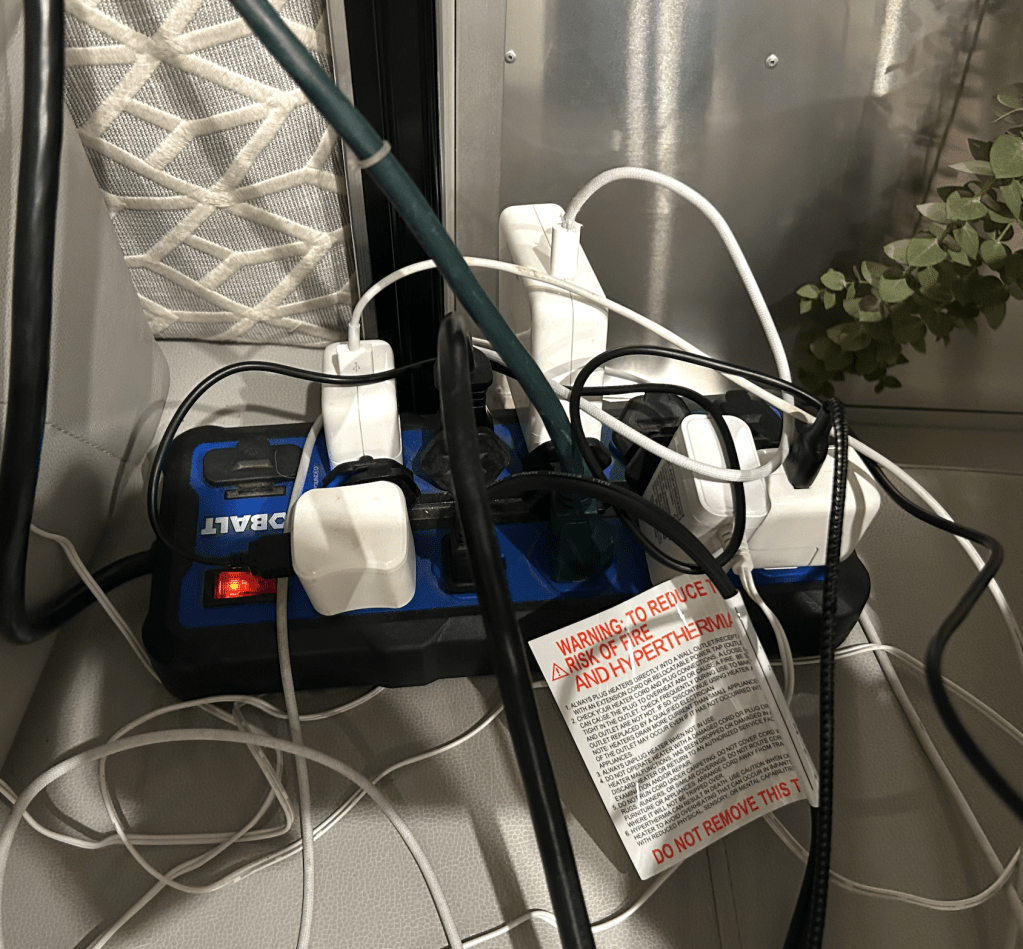
Why we needed an extension cord
Turns out the battery was critical. Tom the technician confirmed we could use the battery power without the inverter. The battery (if it stays charged) can power the refrigerator (which runs off propane when it doesn’t have AC), the lights, and the furnace and hot water heater (which need power to light and blow the furnace fan).
We turned into fanatical battery charge level watchers. There is a gauge above the kitchen counter that lets you know how charged the battery is. We never knew why we would care about that, but now we did. When the battery is at 13.4 volts, it is fully charged. When it gets below 12.0 volts, it starts to shut down. Without shore power, the only charging of the battery happens from the solar panels, which in our case were pretty wimpy because the rain was starting. We would watch the power creep up towards 13.0+ during the day and then dribble down, a painful 0.1 volts at a time, to where everything would stop working.

The all-important battery monitor (of course, happily at full charge now)
The first battery charger we got turned out to be a bust because you need a special charger to work with lithium batteries. (Why would we know that???) By the time we figured everything out and got the right charger, the inverter was fixed and we were ready to go.
On Friday at 2 pm, we headed on the road to our next neighborhood, five hours north in Carmel, more appreciative of the comfy cocoon of aluminum we were living in than ever before – and now armed with the equipment and protocols to handle the next power failure. Bring it on! We have everything we need! It can’t harm us!
Karmic Balancer #2 — Revenge of the Weather Gods
By the time we got to Pismo Beach, we had traveled for over 100 days with only 5 days of rain, only two of which were serious downpours. In other words, a 95% sunny trip. That’s why you travel to the Southwest in the winter, right? Well, the tides turned, starting with several days of rain in Pismo. We did have a clear day for the drive up the Central Valley to Carmel, and one partially clear day to drive down the famous Route 1 Pacific Coastal Highway to Big Sur.
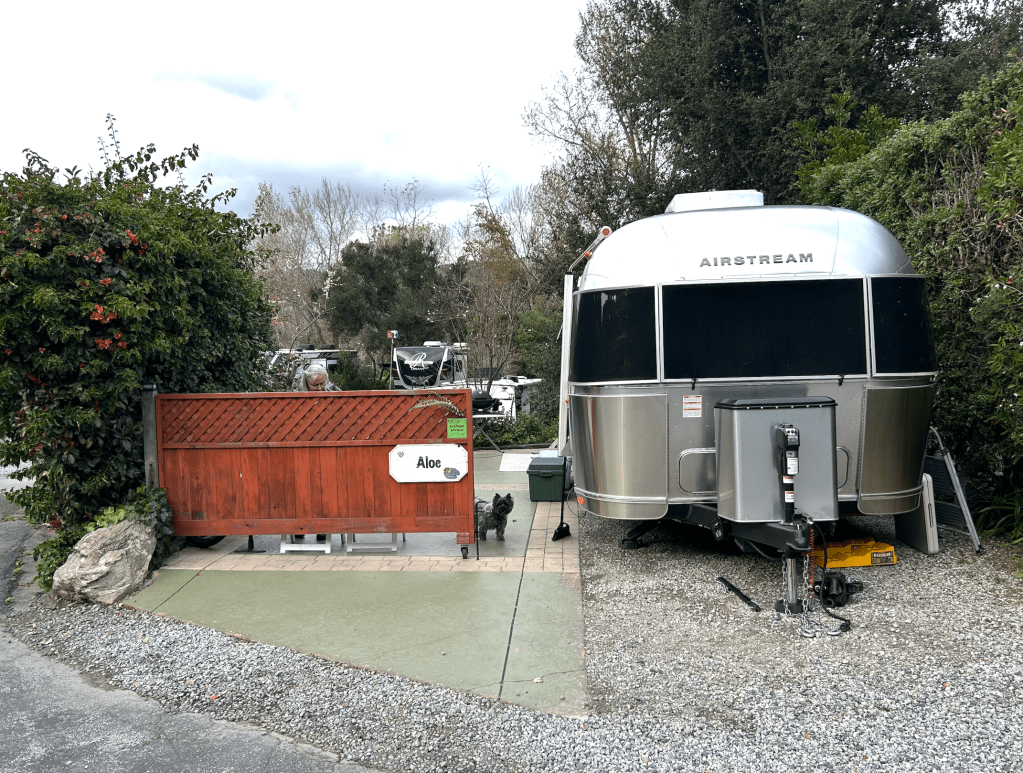
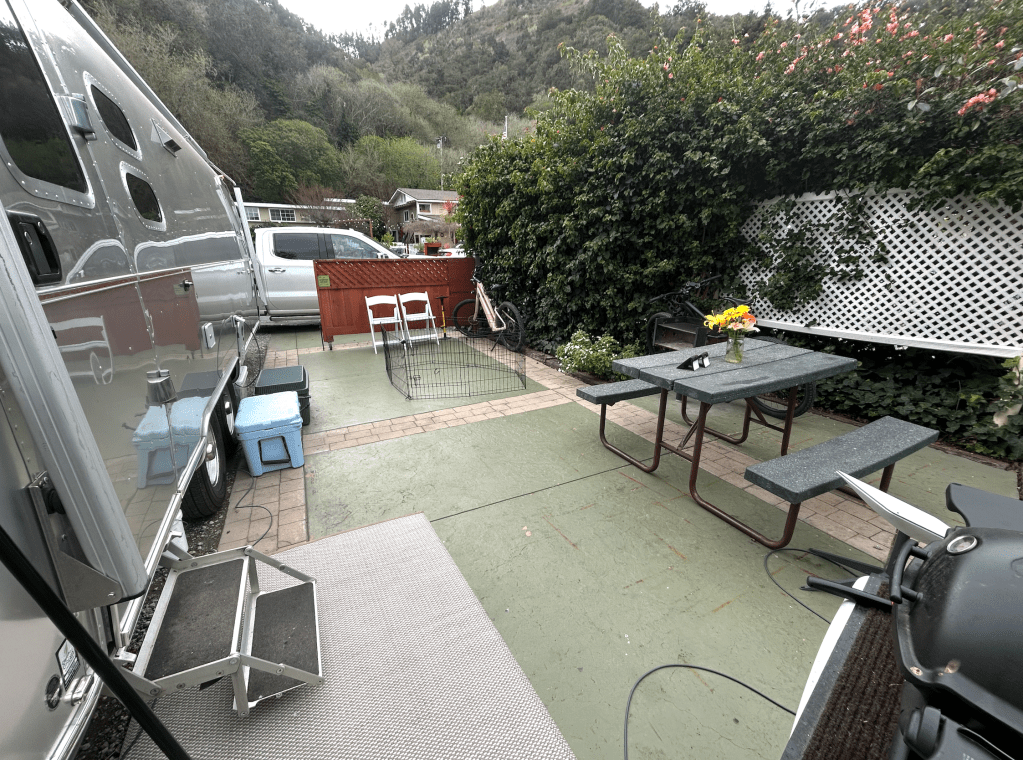
Our cozy home in Carmel
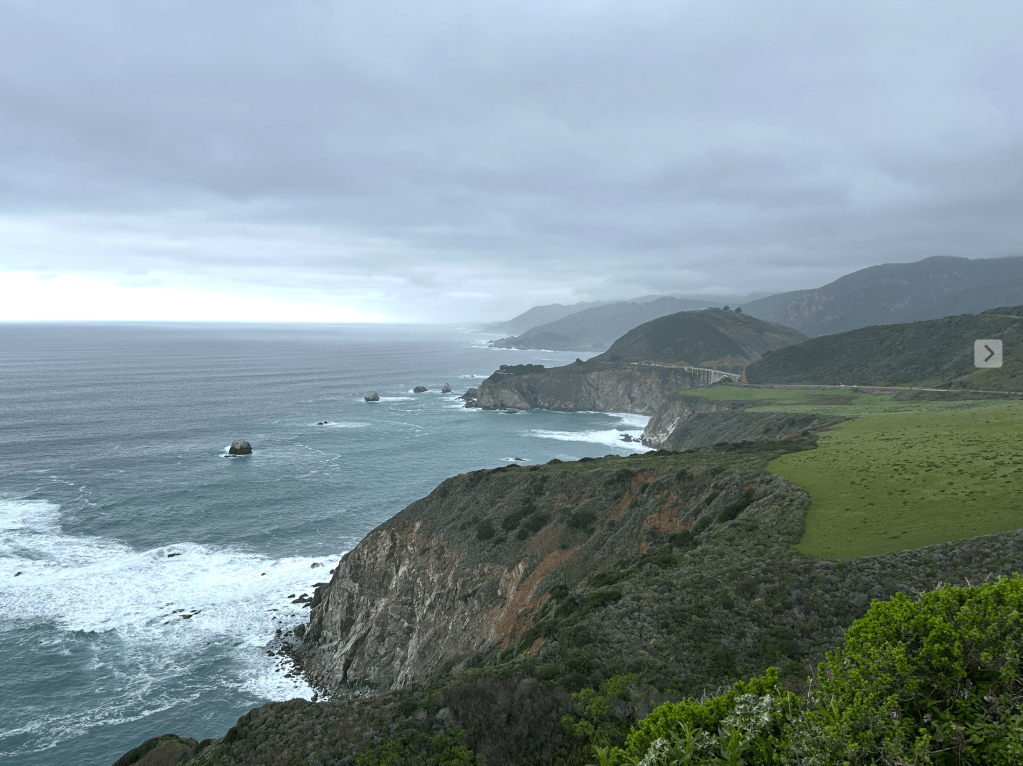
No wonder this is a famous drive!
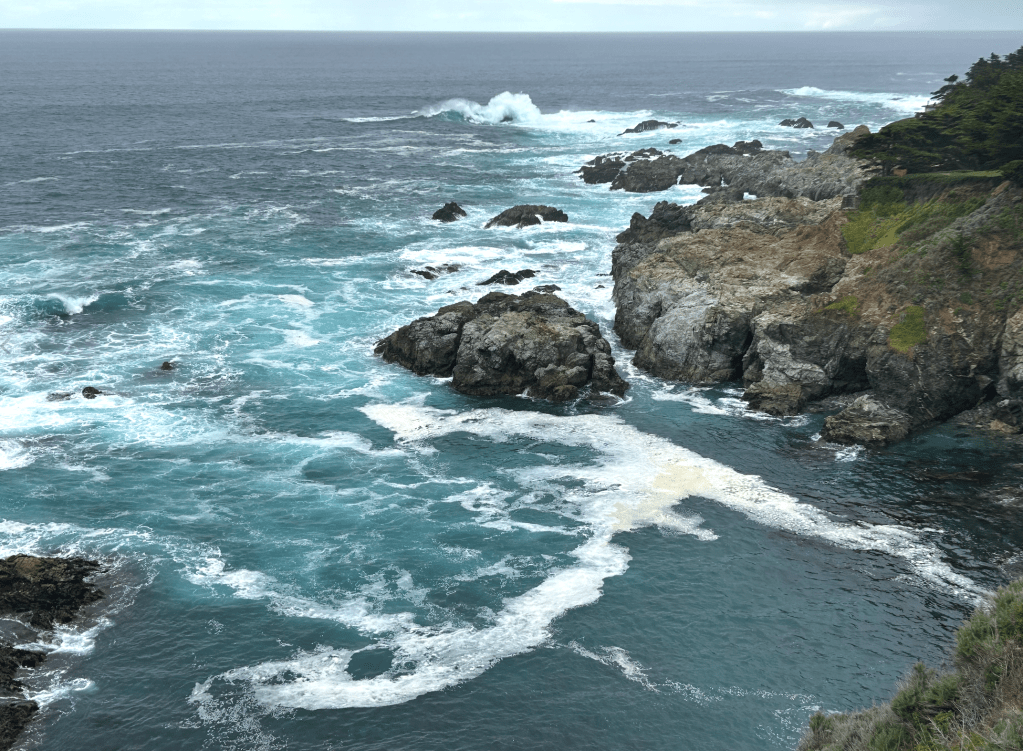
We couldn’t get over the blue color of the ocean water
Then the rain came. Driving rain, complete with lightning and thunder, high winds, flood warnings and even some hail. Temperatures dropped to the low 40s at night and low 50s during the day.
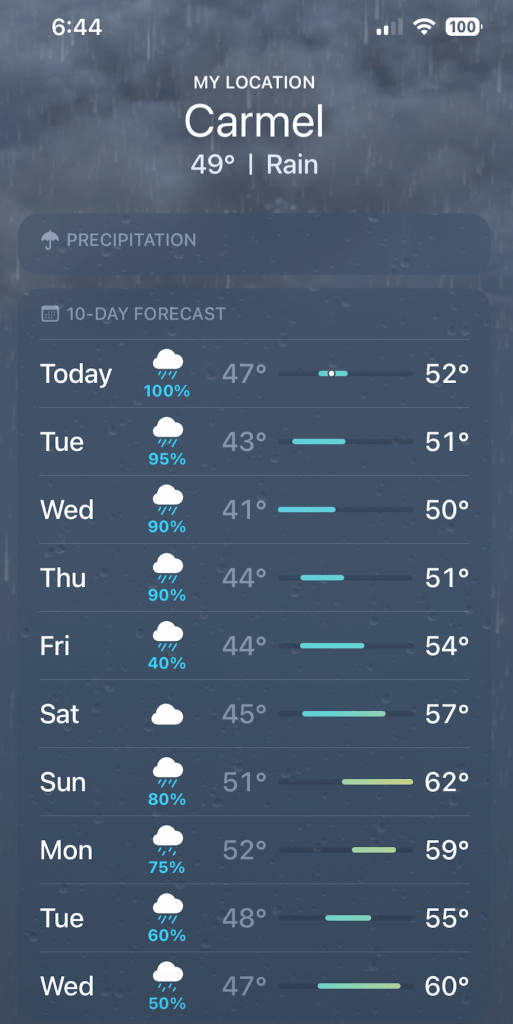
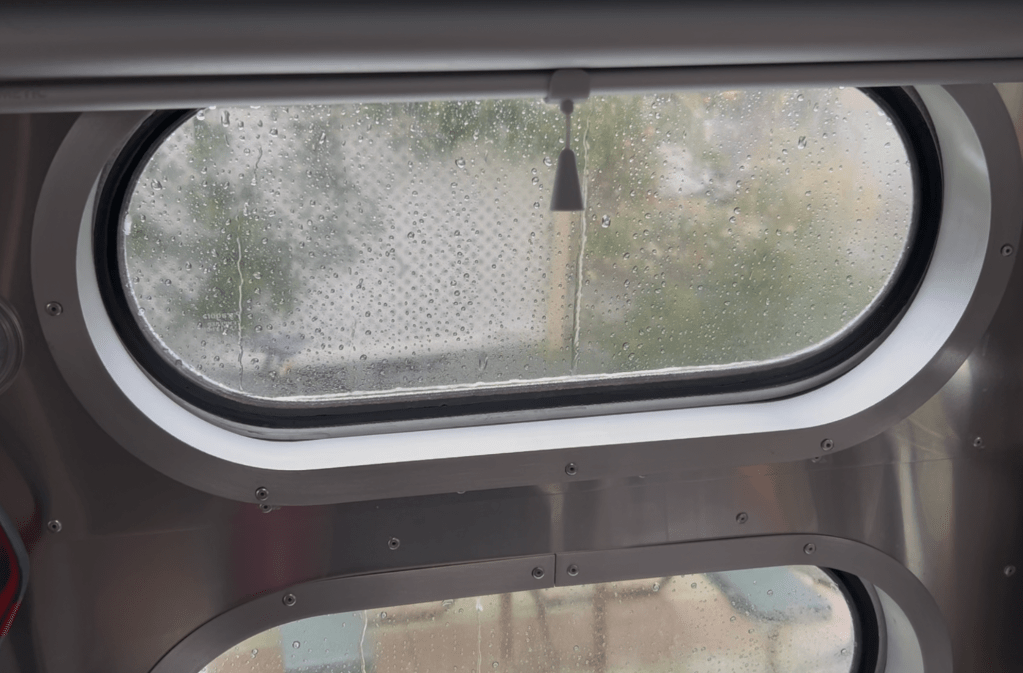
A dreary forecast
Rain changes your trailer experience, inside and outside. On the outside, it keeps you from exploring the natural and cultural wonders you traveled across the county to experience. On the inside, it makes 190 square feet feel much smaller than it usually does, because you are no longer open to the outside. (Seven days of Michigan rain in our original 16’ trailer is what inspired our first Airstream purchase!)
And then there is the dog management. Three wet dogs makes the trailer feel even smaller. We dry them with towels when they come inside after their potty walks, but they are still wet. (We contemplated trying out the hair dryer on them but were sure that would not settle well with them.) So you get used to the smell of damp dogs (“eaux de chien”) on all the surfaces the dogs hang out on, including our bed. There are no dehumidifiers to take the moisture out of the trailer so you just live with it, knowing eventually it will get warm and sunny again.
Potty walks become kamikaze raids triggered by silence – meaning the rain is not falling on the trailer anymore. Lots of time there aren’t breaks in the rain that match the bladder and bowel rhythms of the critters, and you just have to go out and get wet. On those occasions there is an urgency to the dogs doing their business and interestingly they seem to get it and get on with it faster than they might otherwise. I guess they don’t like being wet any more than we do.
There are also upsides to the trailer rain experience, of course. Rain in an aluminum tube makes a symphonic sound as the drops hit the outside surfaces. It is steady when the rain is steady and has a wild rhythmic beat when the wind is whipping it around. The hail adds another “instrument” to the symphony, like crashing cymbals. As you hunker inside, you end up with a deep appreciation for simple “shelter from the storm” and the trailer feels much cozier than it usually does. Because it is all aluminum, you can fanaticize that it is more waterproof than it might be (not true, of course), increasing your sense of security and safety.
We learned one more important mechanical trailer thing in the rain in Carmel. On our third day there, our electric outlets mysteriously stopped working. A quick Internet search pinpointed the “GFCI Protected Outlets” as the culprit. I had seen these strange blue labels on the outlets, but never known what they meant. Turns out GFCI stands for “Ground Fault Circuit Interrupter” and it
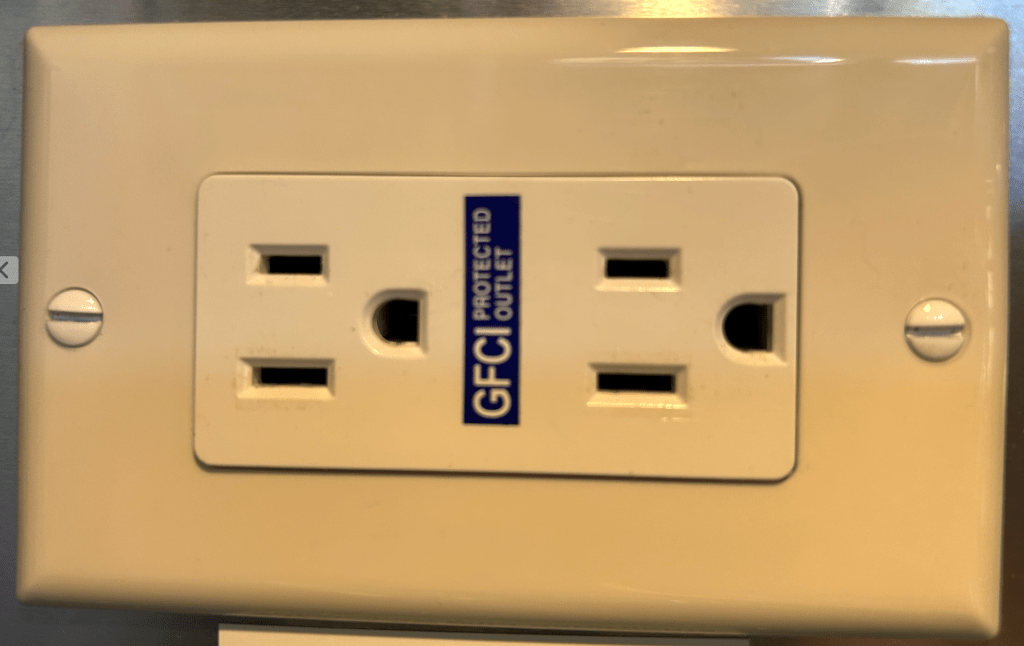
Who would have thought this silly label actually mattered??
compares the electricity going out on the hot wire vs. electricity returning on the neutral wire. If even a tiny amount of current is “missing”, it assumes electricity is leaking somewhere. So it shuts power off instantly to prevent electric shock or fire risks.
The solution is to reset the GFCI circuit breaker and look (primarily) for damp sockets that might allow for a short. Sure enough, in the rain we still had our Starlink modem plugged into the exterior outlet. I reattached it to an extension cord (with the handy adapter I had acquired in the inverter snafu), dried off the outlet, and Voila! no more outlet failures. The sense of self-satisfaction at having figured this out cannot be over-estimated!
The serious rain in Carmel lasted six days. Then the sun came out. My, did it feel glorious! We took a delightful drive around the Monterey Peninsula on the 17 Mile Drive – home of the world-famous Pebble Beach golf course (where, BTW, the average home price seems to be in the $10 million range…). The post-storm winds were still whipping the ocean into a frenzy, and the clouds were creating “stairway to heaven” light visuals. What a treat!
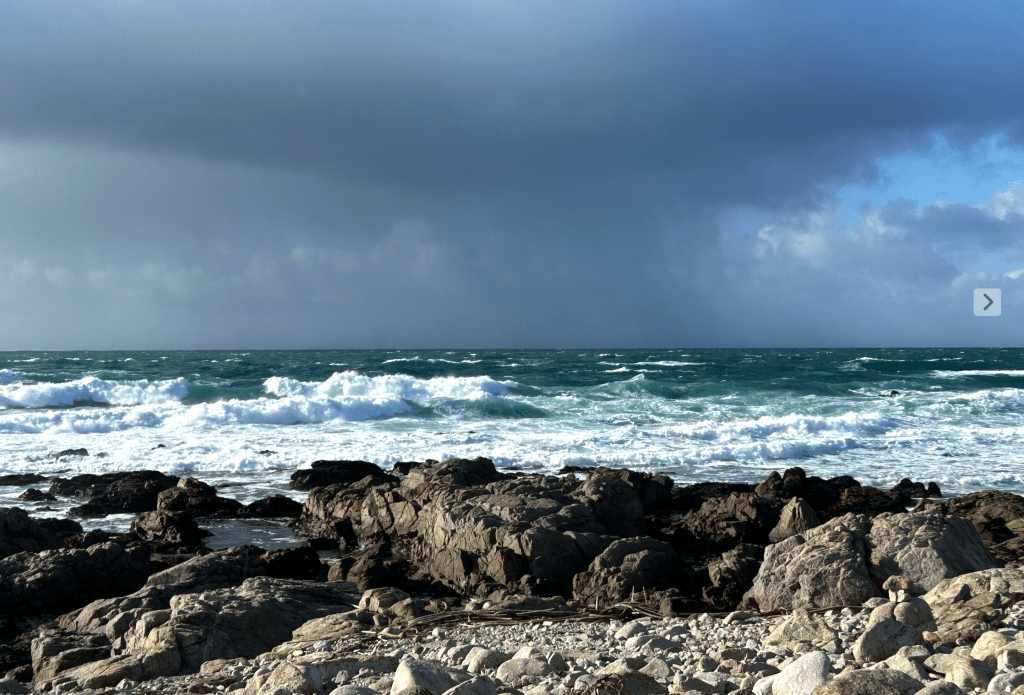
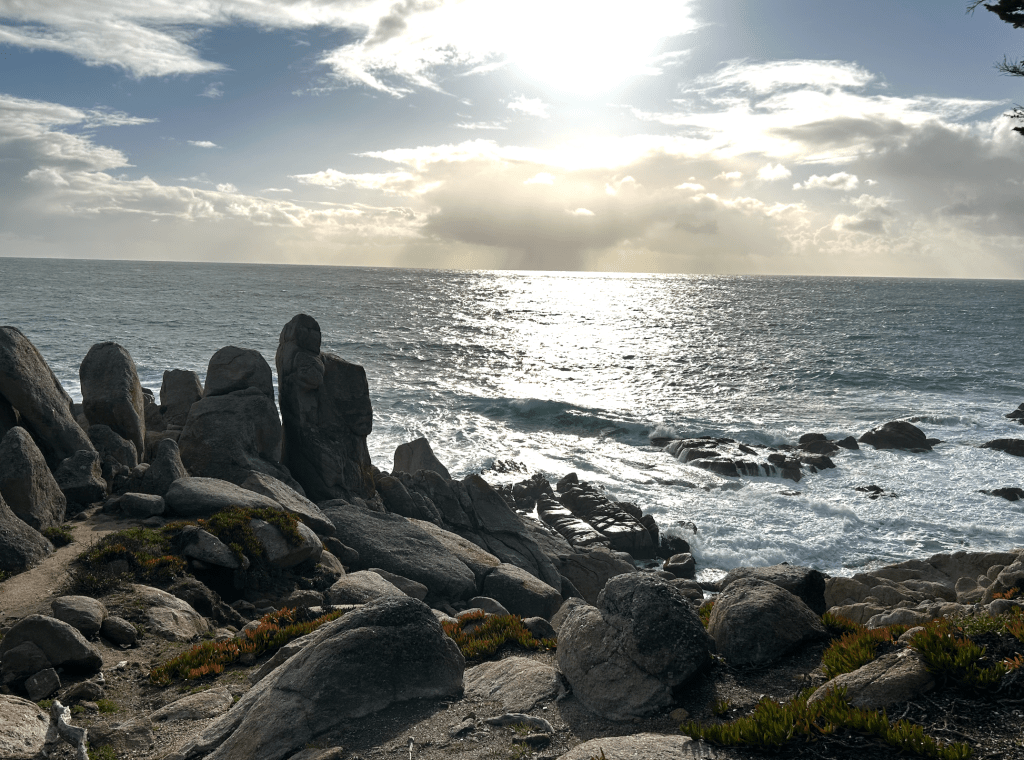
Glorious post-storm shorelines
Karmic Balancer #3 – Bob Puts His Blinker On For the Off Ramp
Every dog owner knows that getting a new dog is always a bittersweet experience. Sweet because you are getting a new life companion who will love you unconditionally and who you can love unconditionally. Bitter because you know that you are signing up for eventually sharing your new pup’s passing, and all the poignant grief that comes with it. Sitting in Pismo Beach in our dark, cold and wet trailer, we thought that the “bitter” stage was coming due for Bob.
Bob is the oldest of the three cairns who travel with us. He turned 14 on February 20. (Wren is just two and Raven is a bit over three.)
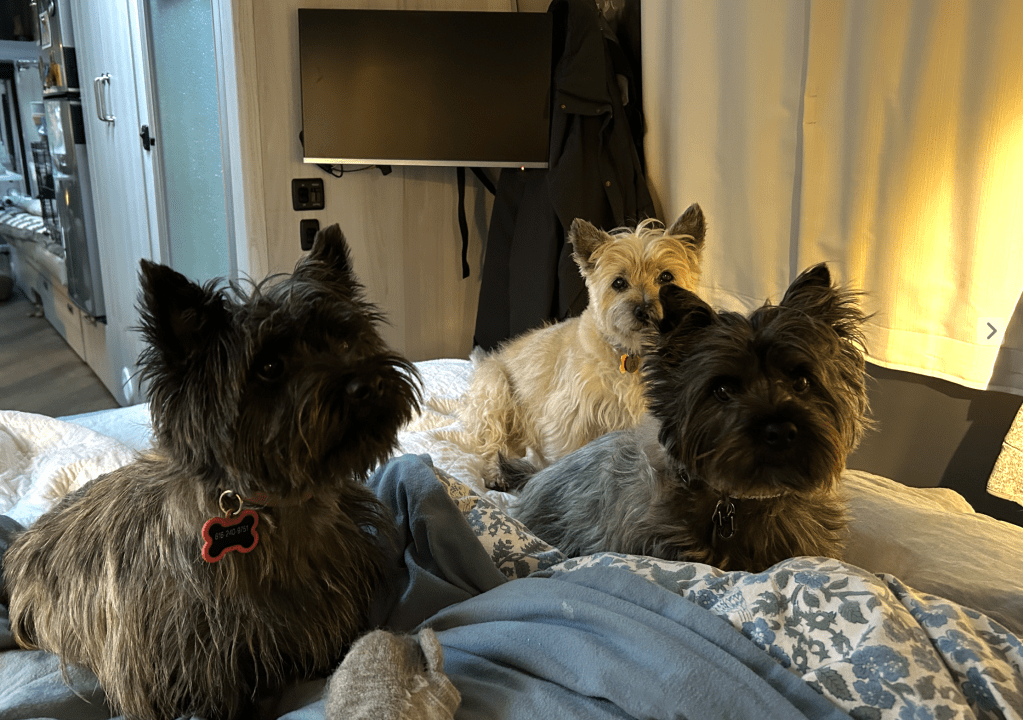
Wren, Bob and Raven waiting for their crust allocation from Michelle’s morning toast
We never planned on getting Bob in the first place. In 2012, we were picking a new puppy (Brimstone) to accompany our first cairn. To our surprise, the breeder offered to give us a “two for one deal” if we would take his brother, who was the last puppy from a five-pup litter. She didn’t have a buyer for him, said he was really attached to his brother and wanted to “move him on” so to speak. How could you say “no”? We went home with two dogs, not one.
Michelle gave Bob the legal name of Robert the Bruce, after the Scottish king we enjoyed watching in Braveheart. We shortened it to Robert for convenience. That didn’t last long. When our son Sam first met Bob, he immediately exclaimed: “He’s not a Robert, he is a Bob!” It stuck and he has been Bob ever since. (Most everyone else seems to agree with Sam’s assessment.)

Bob as a young pup
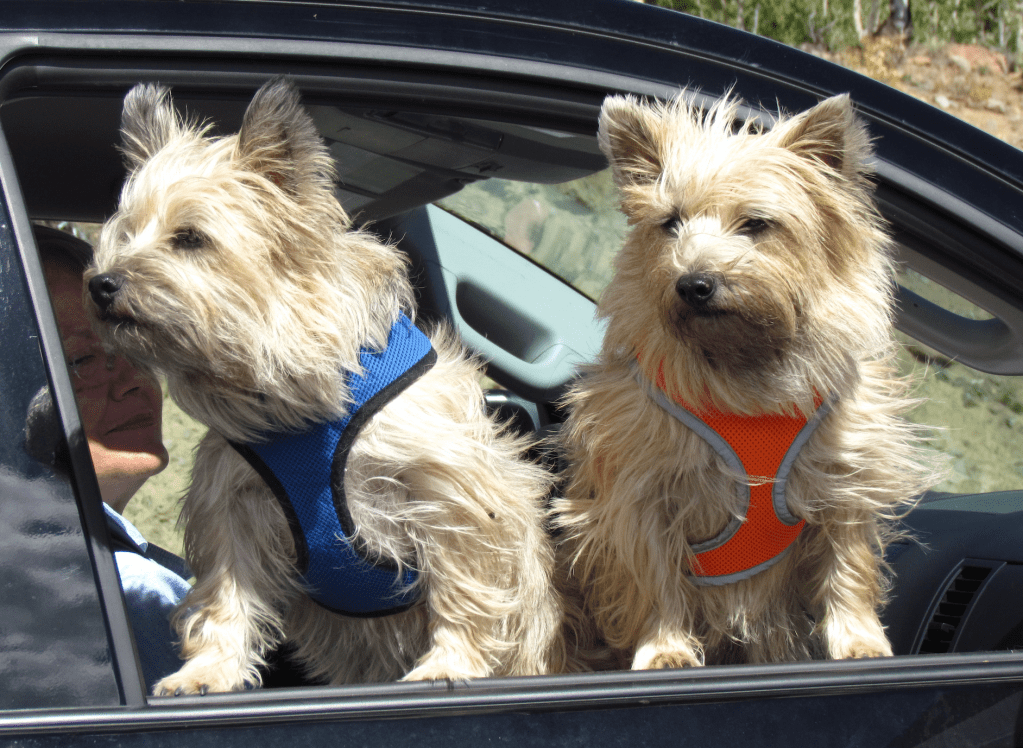
Bob and Brim enjoying their first trailer trip
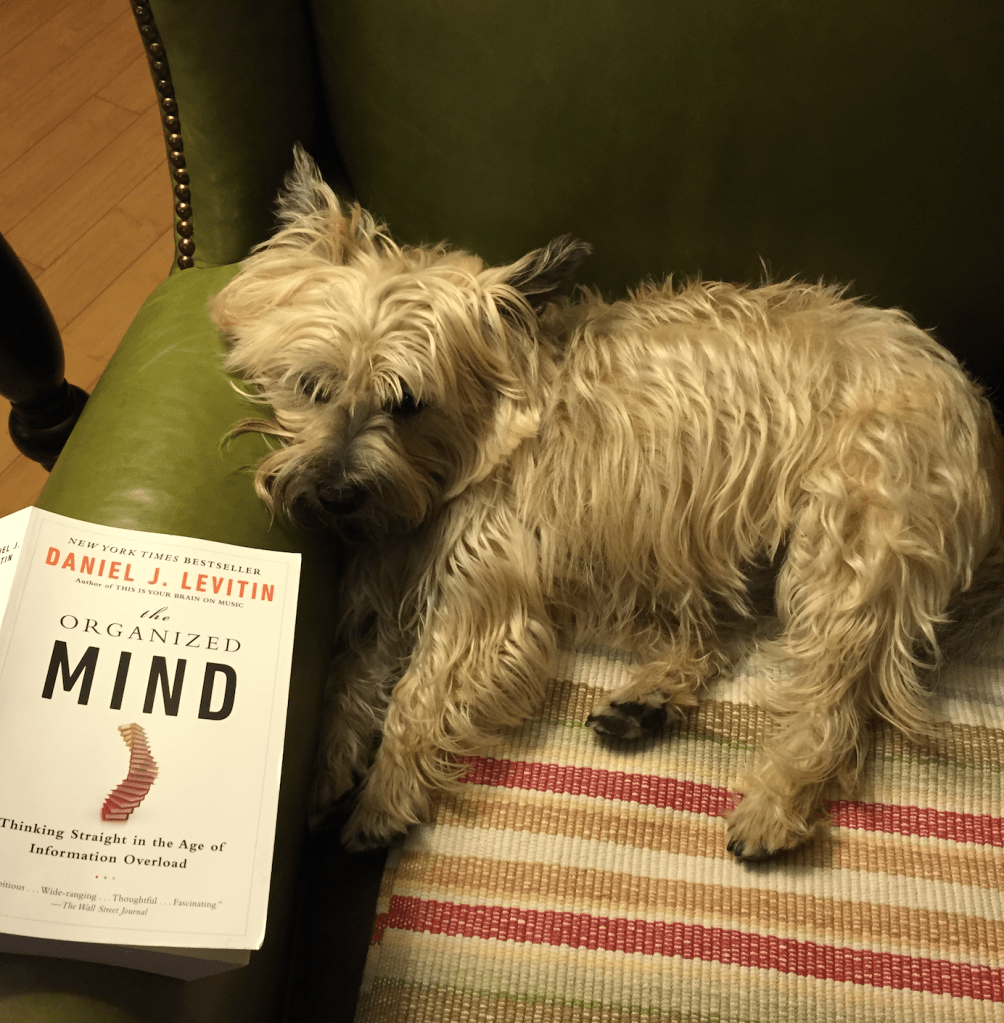
Bob relaxing after some heavy reading
We never planned on Bob joining us for this trip. In the spring of 2024 (when we began planning for this trip) we thought Bob “had his blinker on for the off ramp”. He was 12 at the time, and as often happens with elderly canines, he experienced a momentary decline that we thought was a permanent one – no longer eating properly, loose bowel movement, lots of moaning from what we assumed was body pain – all the signs of end-of-life processes.
Our other pup, Raven, was just one year old. (We had gotten him to replace Bob’s brother Brimstone who passed from cancer.) We knew cairns like to have companions so if we were going to travel with two after Bob passed, we needed to get a new pup soon so they could be at least one year old by the time we left. (We didn’t want to be potty training in the trailer.) So we made a bet and got Wren, upping our dog inventory from two to three for what we assumed would be a short period of time.
Bob had other ideas. Shortly after Wren arrived, he abruptly turned his blinker off and popped back to his normal self. So we headed off on our Grand Adventure with three dogs instead of two.
In Pismo, it appeared that Bob had turned his blinker back on. He stopped eating, got diarrhea, and had some flecks of blood in his feces, and would often go out (in the rain) and just stand staring and not quite knowing what to do. All of these were not good signs. We didn’t relish the idea of managing his passing on the road, much less in the rain with a broken trailer.
Michelle did some quick Internet research, and we totally changed Bob’s diet. We dumped the dog kibble and replaced it with a combination of oatmeal, rice, pumpkin puree, bone broth and boiled skinless chicken breast. It had a miraculous effect. After a week, the blinker was off once again, and Bob was back to his normal old dog self.

Bob with his blinker off
Moving On With More Balanced Scales
So we headed out of Carmel for Napa Valley feeling like we had smoothed out some bumps in our road. Our trailer was fixed, the weather was great, and Bob was back. We had learned a lot – about ourselves, our home on the road, and our canine companions. And we had a renewed appreciation for all the blessings our Grand Adventure has brought.
Blessings, gratitude and awe to all of you!
John, Michelle, Bob, Raven and Wren
 John and Michelle's Grand Adventure
You must be logged in to post a comment.