Our last days on the California coast were spent in Avila Beach (where we had stayed previously) and the Pacific Dunes RV Park (10 miles south) which backed up to about a square mile of gorgeous sand dunes.
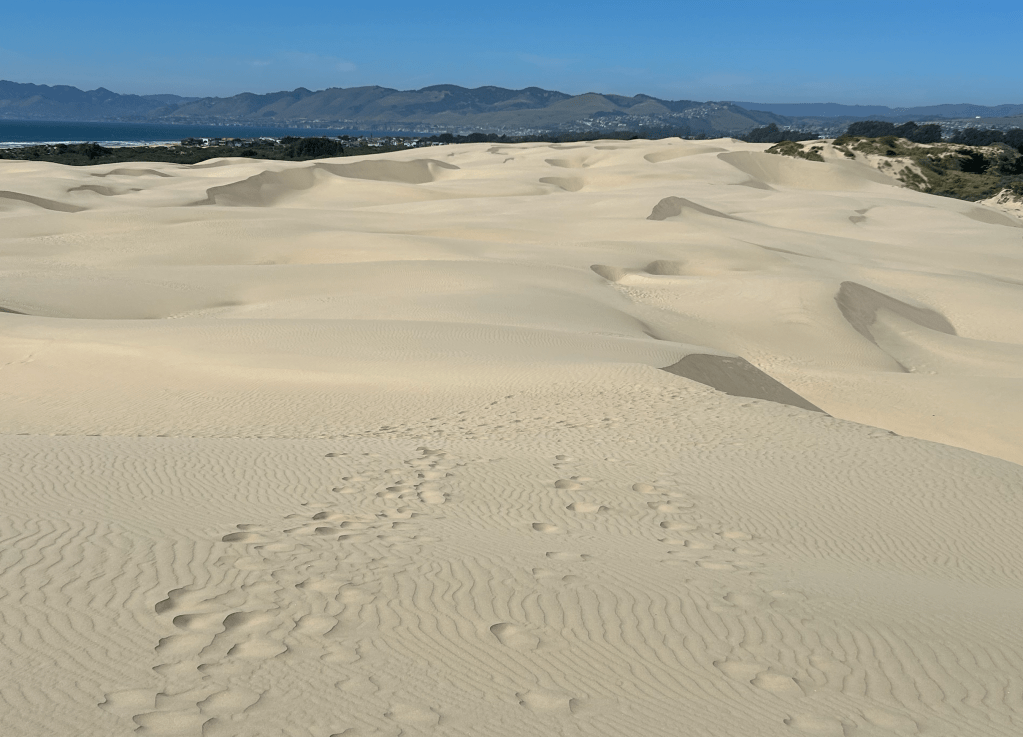
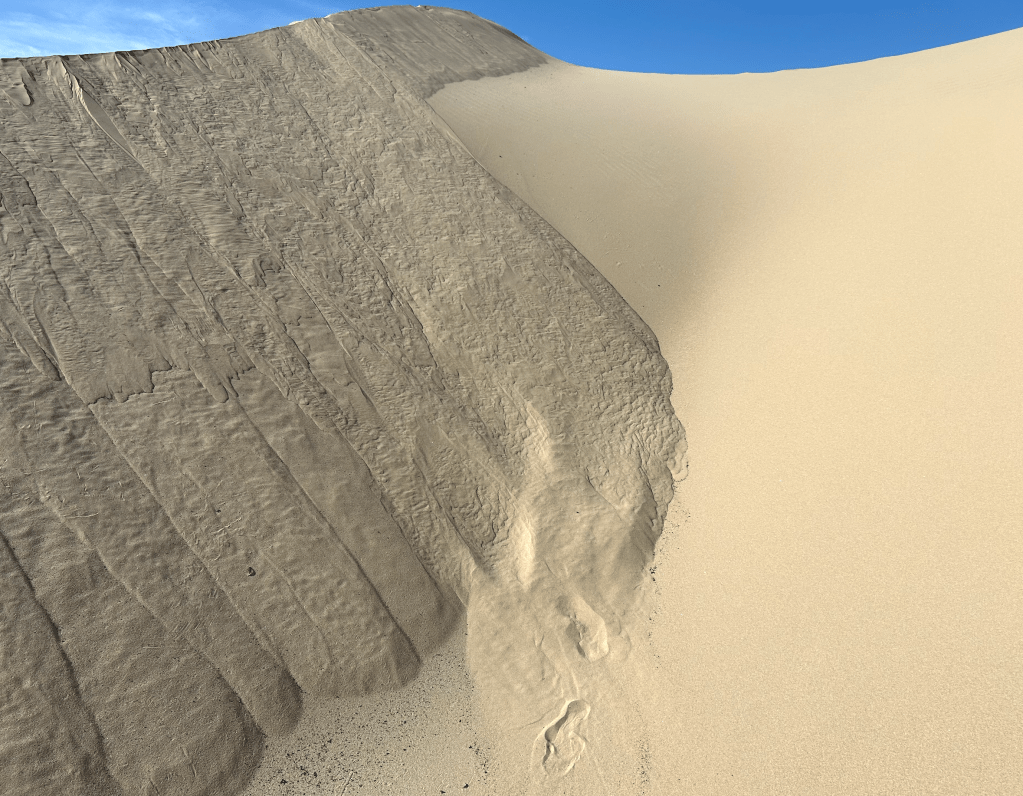
Who needs the Sahara when you can have Pismo dunes?
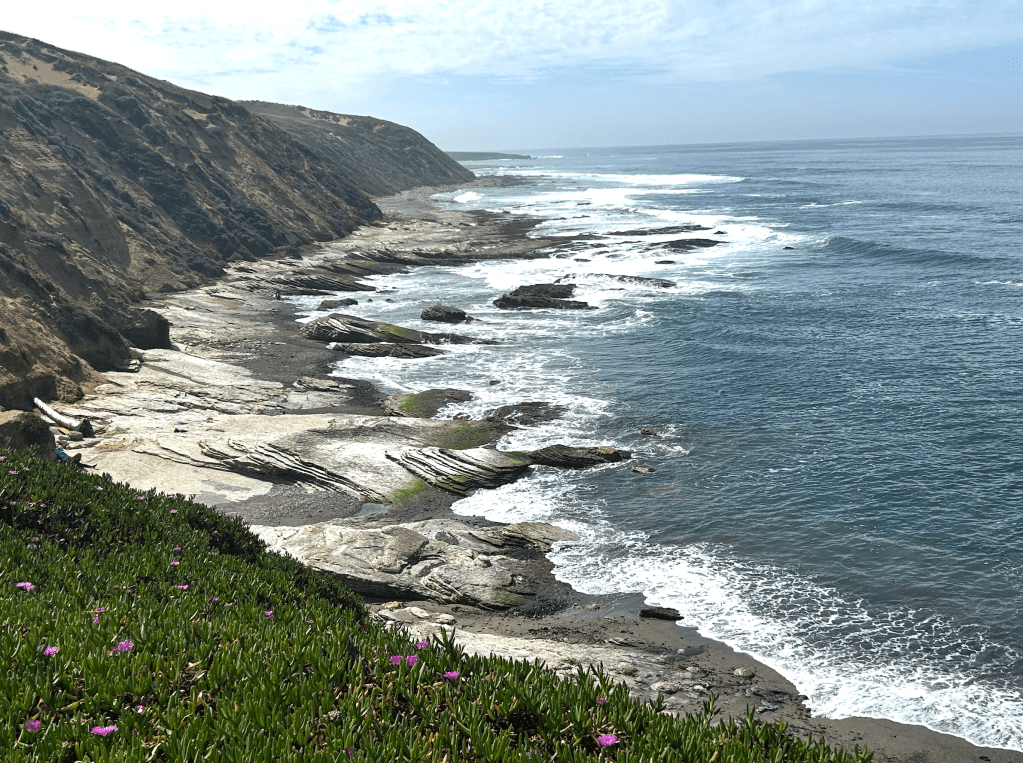
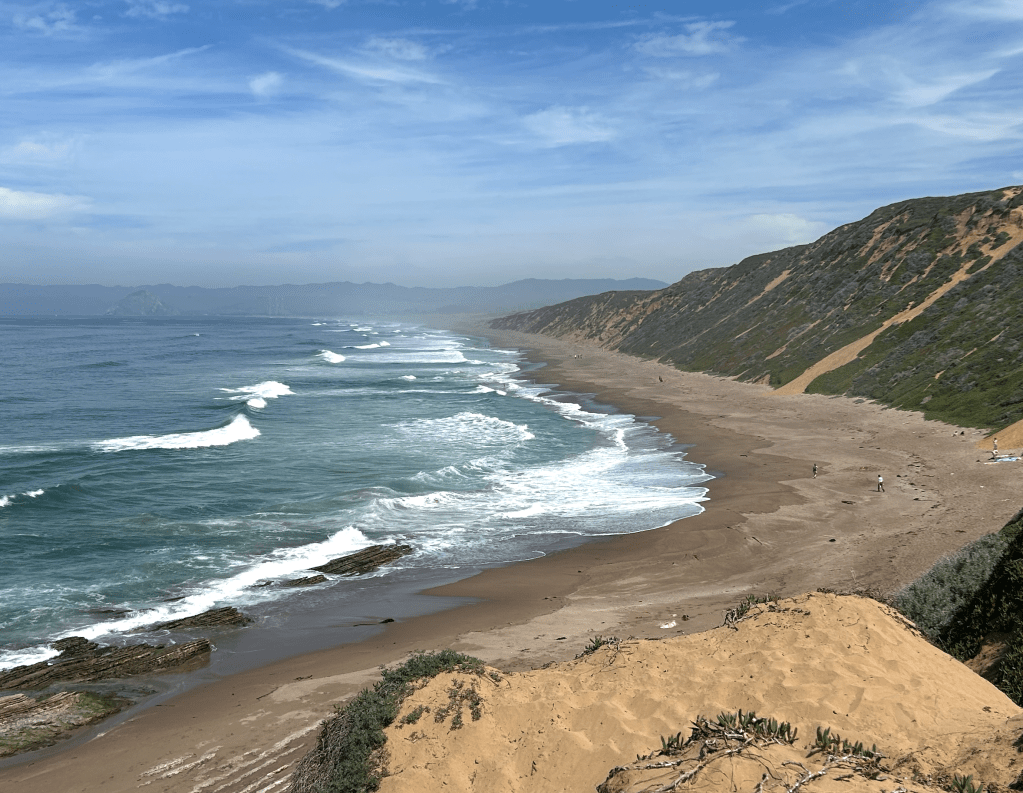
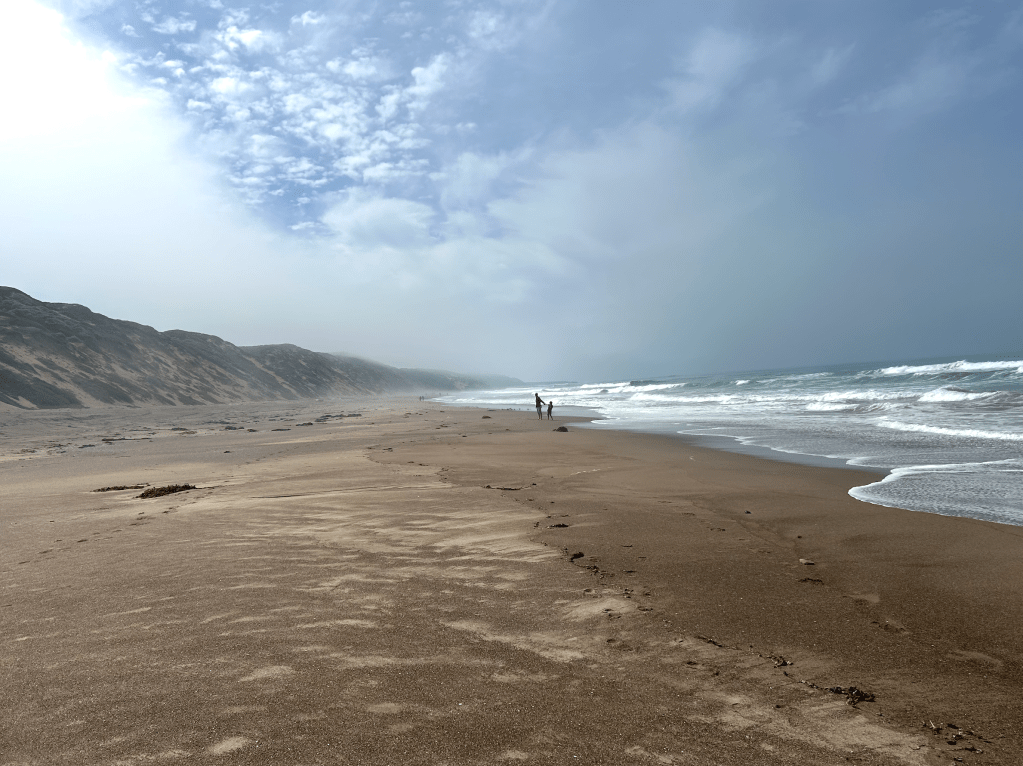
Delightful “no suffering” beach hikes in the Montana Del Oro state park south of Morro Beach
Our next destination was Beatty NV, just outside of the Death Valley National Park. We weren’t planning on visiting Death Valley, but Josh and Liz showed us their pictures from an earlier visit and they were magnificent. It seemed silly to drive by them on our way to Zion and not visit. We left Oceano on Thursday, March 26. Our mission was simple: drive to Beatty NV, about a 7-hour trip. The fates had something else in mind for us – a FUBAR day.
A FUBAR Day Blow By Blow
FUBAR stands for “Fouled Up Beyond All Recognition” (usually with the stronger F-word replacing “fouled”.) Its roots are in World War II, where it allowed soldiers to quickly acknowledge the chaotic and dangerous situations they so often found themselves in. (Some of you may remember it from its use in the great war film, Saving Private Ryan.) It got integrated into civilian life following the war and is now commonly used to describe situations that are hopelessly messed up.
Here is the blow-by-blow of our “hopelessly messed up” day.
8:00
We plan on leaving the RV park at 8:00, but because I forgot to put air in the trailer tires, we leave a half hour late.
8:34
Minutes after leaving the park, we turn left towards our route and Bob (who rides sitting on a pillow on Michelle’s lap) vomits his entire dinner meal on the pillow, Michelle’s lap and part of the truck console. Skanky (you will find this term characterizes many parts of the day!) yellow bile is everywhere. We pull over quickly and execute the first of several “Mr. Wolf interventions.”
We cannibalized the Mr. Wolf terminology from the Pulp Fiction movie, where Harvey Keitel plays a mafia “cleaner” named Mr. Wolf whose job it is to scrub crime scenes of any remaining evidence and mess. He is the one who expertly cleans the car in which John Travolta inadvertently blows the brains out of his passenger in the back seat.
While Mr. Wolf used voluminous quantities of fabric towels, we used primarily paper towels and lots and lots of Clorox spray.
8:49
Bob’s mess has been made to disappear, a skanky bag of laundry is put in the back of the pickup, and we are ready to get back on the road.
I remember I forgot my hearing aids (critical for car conversation) and go back to the trailer to get them. Michelle had put them above the bed on my side. I walk to the back of the trailer and retrieve the hearing aids, insert them and exit the trailer. When I turn around to close the trailer door, I notice my footprints on the floor and a skanky smell. Upon further investigation it becomes clear that little miss Wren (our youngest cairn) had sneakily deposited a pile of poop in her favorite go-to location – my side of the bed. Which I promptly stepped in and tracked all through the trailer, include across two small floor rugs.
A massive burst of cursing ensues.
When the cursing ends, the Mr. Wolf Maneuver #2 is initiated. This again requires a vast quantity of paper towels (luckily, we usually have at least four rolls of Bounty on board, something Michelle make sure of) and a large volume of the poop and pee wonder cleaner: “Nature’s Miracle – Advanced Severe Mess Enzymatic Formula Stain and Odor Eliminator”. (I kid you not – that is the name right off the label.) An extra maneuver involving a table fork and quantities of water is needed to get the unwanted material out of the sole of my Oboz hiking boots, whose deep treads are designed for stepping in trail mud, not dog poop.
9:10
We finally head out on the road to Beatty Nevada, over an hour off our schedule.
12:00
We have a tasty lunch of yogurt (Michelle) and Clif Bars (John) outside of Bakersfield CA. We muse about the extraordinary vastness of the agricultural miracle of the California Central Valley. Michelle comments on the bleakness of the terrain, an agitation that increases as we go.
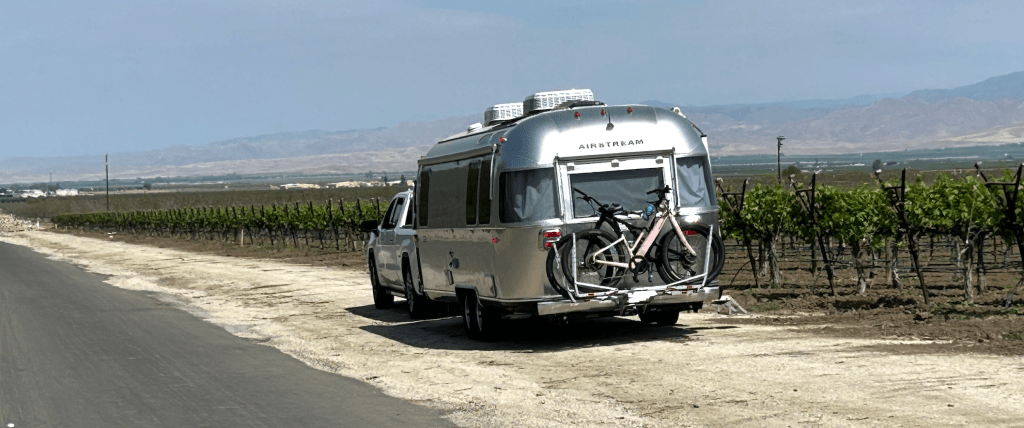
The Grand Adventure luncheon diner
12:30
Shortly after our departure from Bakersfield, Raven, our three-year-old cairn, starts panting heavily, something he has never done before. (To the contrary, we have often waxed eloquent about how our cairns are such excellent travelers, never panting or drooling like other dogs.) We still have no idea what prompted this change in behavior.
While Bob is in the front on Michelle’s lap, Raven and sister Wren are normally in the back seat in a crate. As we drive toward Beatty (not looking forward to five hours of panting) we experiment with multiple strategies designed to slow down the staccato (and very irritating) noise from the back seat. Attempted remedies include opening the windows, playing load music, letting Raven out of the crate, (upon which he promptly jumped into the front seat on Michelle’s lap) pouring cooling water on this head (which made him look vaguely like a wet otter) and letting him out to walk (a strategy that was not helped by the fact that during our drive the temperature relentlessly increased until it got north of 100 degrees). Nothing worked. The end result was Michelle sitting in the front seat with two dogs, one panting and one not. The panting lasted until he got out of the truck in Beatty NV.
2:30
Stop to get gas. The pump reader is not working, so I have to go inside to get gas. When I go back to pay, I try to use the ATM to get some cash. The ATM is broken.
Michelle comments again on the bleakness of the terrain.
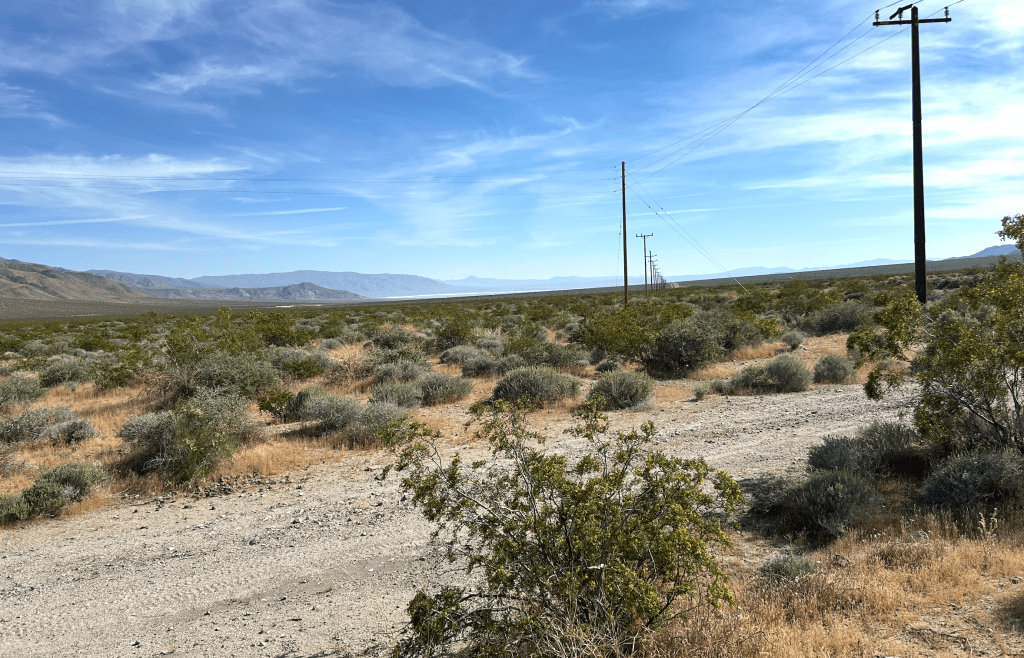
Desolate, bleak or interesting?
5:50
The Grand Adventurers get to the Death Valley RV park ten minutes before the office closes. A young team of Leo and Karen get us registered. They go up in my estimation when they complement me on my tattoos. I ask for information on Death Valley, which they don’t have. Karen gives me a brochure someone else left. It turns out to be in Chinese.
Beatty is a dusty and dreary town of about 800 with a median income of $24,000 and an average age of 62 that not long ago had the distinction of having more wild burros in the town than residents. In 2024 they removed the wild burros, which put a dent in Beatty’s tourism visits. The RV park of 30 dingy sites matches the Beatty vibe and is dominated by long termers who are working construction in the area. Michelle is not pleased by my park selection (longing for luxury of the CA coast), but I ply her with arguments about its proximity to Death Valley and the lack of available alternatives, to no avail. We agree to a truce on the topic.
6:30
The trailer is parked and set up – power plugged in (surging through our new inverter), septic drains connected, water hooked up. I take Bob and Raven out for their post-drive potty walk. A large stray black and white dog – 50-60 lbs – comes out of nowhere. Our edgy terriers are not sure about him. The dog distraction makes it impossible for them to do their business, and we go back to the trailer. The stray dog hangs out on our trailer steps waiting for his new friends to come out. Since the office is closed, Michelle calls Leo and Karen and they come back to figure out what to do. They don’t have any useful ideas. I end up talking with a nice RV neighbor (construction contractor) who says he thinks he knows whose dog it is and agrees to text him to come pick him up. Eventually the dog gets bored and leaves and never shows up again.
7:30
We finally settle in and get dinner. I have grilled lamb chops and pinot noir – not shabby! – and Michelle has pasta. Pretty soon, Bob starts his “sundowner” routine – moaning inconsolably after dinner. Petting calms him down a bit, but the calming medicine from the vet hasn’t yet arrived. Still, all feels OK. But the day is not done.
8:00
After dinner, I get up to go to the bathroom. I notice some clear liquid on the floor, flowing from the bottom of the door over to Michelle’s side of the bed. The first assumption is that Wren or Bob has emptied their bladder in the trailer. Upon further examination it turns out that it is much worse than that. I open the bathroom door and with horror realizes that the fluid is coming from an overflowing toilet. This can mean only one thing – the water used to flush the black tank is mistakenly on and the black tank (septic water) is flowing into the trailer – every RVer’s worst nightmare. I flush the toilet and rush out to look at the hose.
There are two water inlets on the side of the trailer. One is for drinking water that goes to the sinks and shower. The other is water used to flush the black tanks as you are draining them to make sure all the material gets out and the tank is clean. For the first many years of RVing, my process was to unhook the fresh tank hose and screw it into the black tank flush inlet each time I flushed the tank (which is typically once a day). I had cleverly figured out that an easier solution was to put a “Y” junction in the water hose from the source and have one short hose go to the drinking water inlet and another to the tank flush, with valves to be able to turn both on and off. This eliminated the need to unfasten and refasten the hose each time I did the tank flush. Instead, I just turned the flush valve on and off. The problem with this clever solution is that it eliminated the “fool proofing” process of having to put the water hose back in the drinking water inlet – eliminating the possibility of mistakenly flooding the black tank.
Upon examination, it became clear that in doing the setup, I had not properly shut off the black tank flush valve. So while we took the dogs for a walk and ate dinner, water was flowing into the black tank and eventually out of the toilet and into the trailer.
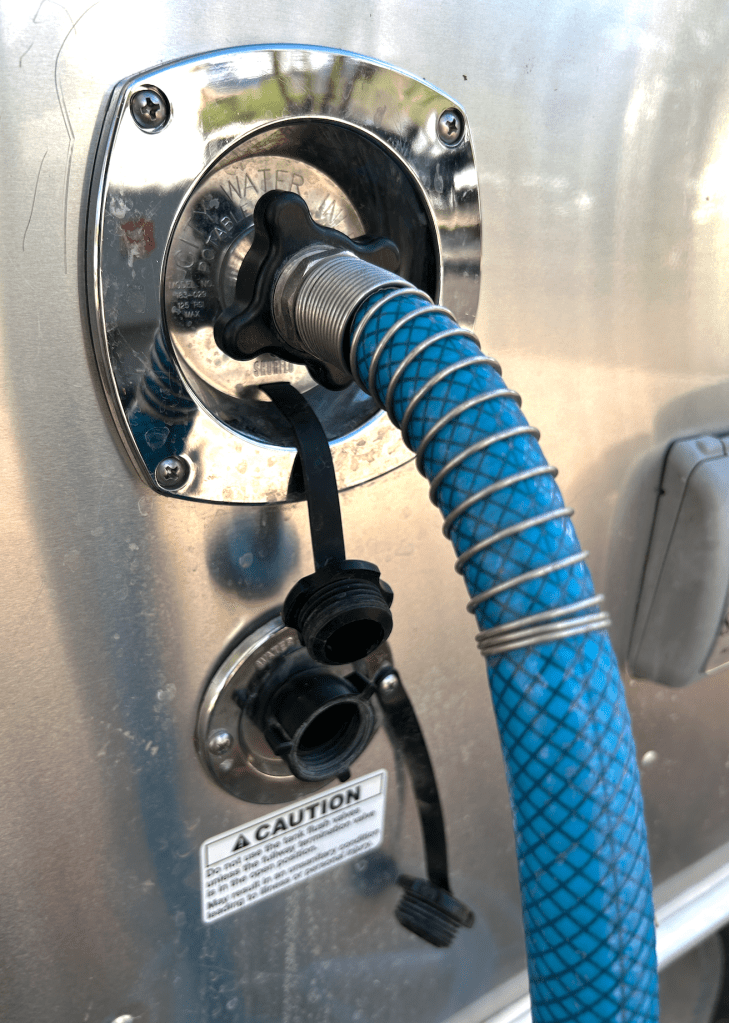
The two water inlets. Note that, under the new tank flushing SOPs, the black tank flush is left unconnected when not used…
The crisis triggers the “Mr. Wolf Maneuver #3” of the day. There was lots of stuff piled on the side of Michelle’s bed because that is where stuff gets put when we travel. Everything on the floor is soaked was septic water. I channeled Mr. Wolf and jumped into action, again with abundant use of paper towel, Lysol and Advanced Severe Mess Enzymatic Formula Stain and Odor Eliminator, which by now is getting in short supply.
When Michelle understands what has happened, she does the only appropriate and logical thing at this point of the day – she dissolves into tears and curls up on the couch. I do not try to console her because it would be useless and because crying is healing.
Another pile of skanky laundry is created and thrown outside the trailer. The wastebasket is full of skanky paper towel from the three cumulative Mr. Wolf maneuvers and is emptied in the dumpster.
8:45
I go to clean the day’s skanky laundry production. There are three total loads of laundry.
While waiting for laundry, I discover an unplanned meeting on my calendar for the next day, screwing up Our travel plans to Death Valley.
There are many signs in the laundry, none of which I read.
9:15
I put the clothes in the dryer.
9:50
I return to the laundry to check on the drying clothes. The laundry is locked. I call Leo yet again. Leo and Karen show up and explain that a third party is hired to lock the laundry at 9:45 and open it at 8:00 am. Leo has two large rings of keys. One of them is supposed to open the laundry. None of them work. He points out that there are signs (which I didn’t read) in the laundry indicating that the last loads should go in no later than 9:00. I note that the type is kind of small and they weren’t over the washers, which is where I looked. My argument is weak and it is clear that I was in the wrong. I agree to come back in the AM and get the clothes out of the dryer. Leo goes home hoping to never see us again.
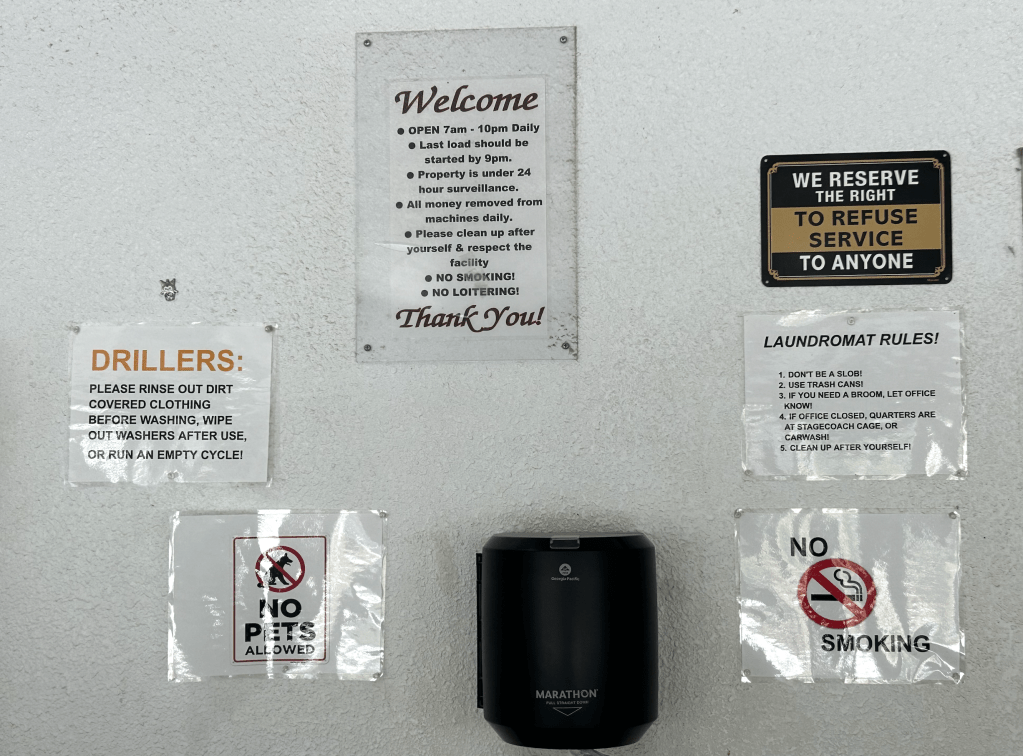
The signs I didn’t read. It is too small, right???
10:30
Time for a shower and bed! I undress and turn on the shower. There is no hot water. I put my clothes back on and go outside to check on the water. The water valve is not fully turned on. The on-demand water heater needs a certain level of water pressure to fire it up. I turn it on and go back in; undress again and finally take a shower.
10:50
Bed and looming sleep! Pups are tucked in and happy; Michelle is curled up and sleeping in the bed, not on the couch; and, as Bob always tells us, “Tomorrow is another big puppy day!”
Death Valley, Another National Park System Jewel
Despite our FUBAR day, we finally got to enjoy the amazing Death Valley.
Death Valley is the largest national park in the US, covering 3.4 million acres and over 5,000 square miles. It holds the record for the hottest recorded air temperature in the world – 134 degrees Fahrenheit in 1913. So I guess now we can claim to have been in the places with the world’s worst hot weather (Death Valley) and its worst cold weather (Mount Washington). While we were there, the Valley set another March high temperature record — topping out at 105 degrees. Death Valley is also the driest place we have been yet on our Grand Adventure – it gets an average of only 2” of rain a year.
It was interesting to see what survives in this kind of environment. As you move towards the central basin, the vegetation gets scarcer and scarce, until pretty much the only living things left are creosote bushes and desert holly. These plant critters deploy some innovative strategies to cope with the extreme drought and heat.
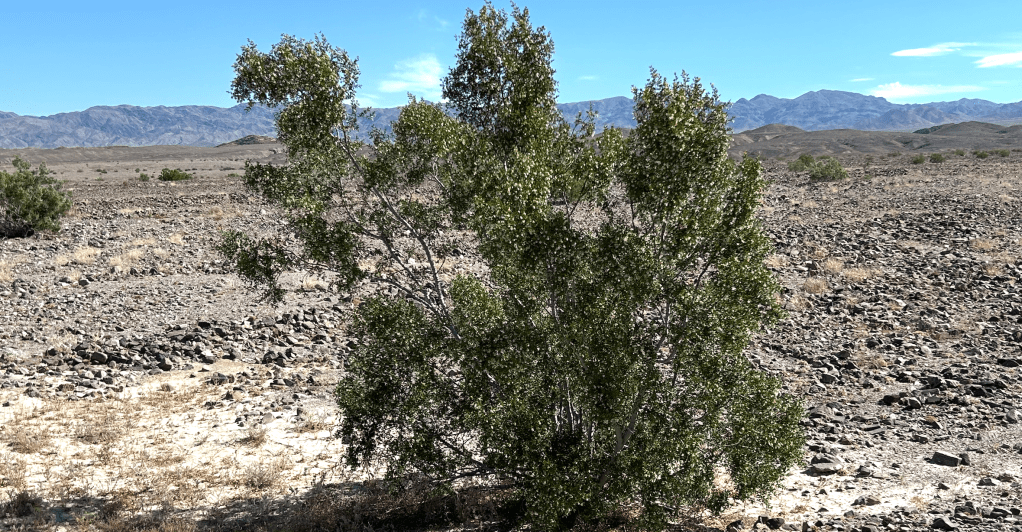
The mighty creosote bush.
The creosote bush can survive multiple year with no rainfall at all – its cells can tolerate dehydration without dying, a rare plant attribute. Its leaves have a waxy layer that reflects sunlight and reduces evaporation, and to keep other plants from stealing its resources, and it engages in “chemical warfare”, releasing chemicals into the soil that inhibit nearby plant growth and reduce competition for scarce water. Finally, similar to how Aspen trees clone themselves by their roots, creosote bushes do the same – expanding into a circle of clones and enduring for thousands of years as old spurs die and new extensions grow.
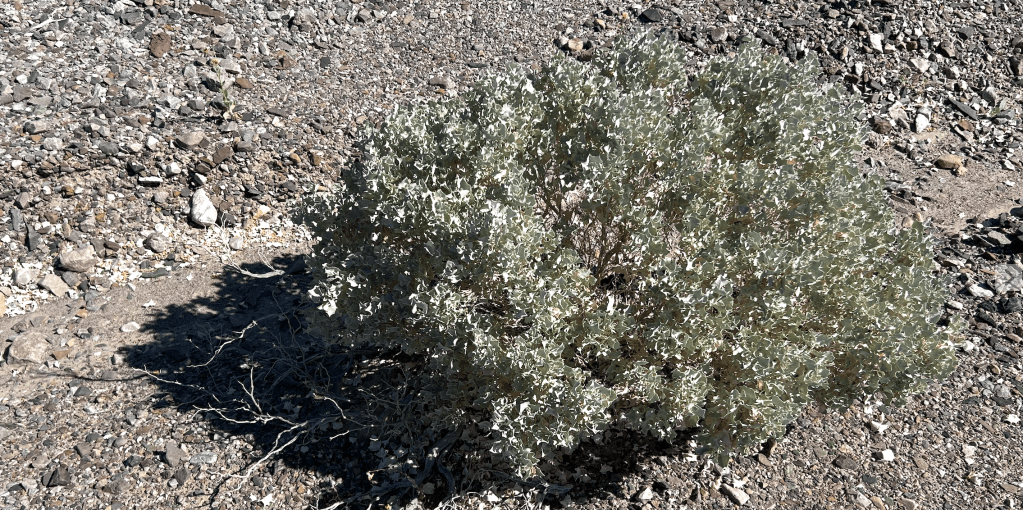
The gentle but tough desert holly
The desert holly employs a slightly different set of strategies, heavily leaning on its unique leaf structure and function. Its leaves have a silver coating of tiny hairs and salt crystals that reflect sunlight, dramatically lowering leaf temperature; they survive in salty soils by excreting excess salt onto leaf surfaces; and their leaves use a highly efficient photosynthesis that minimizes water loss.
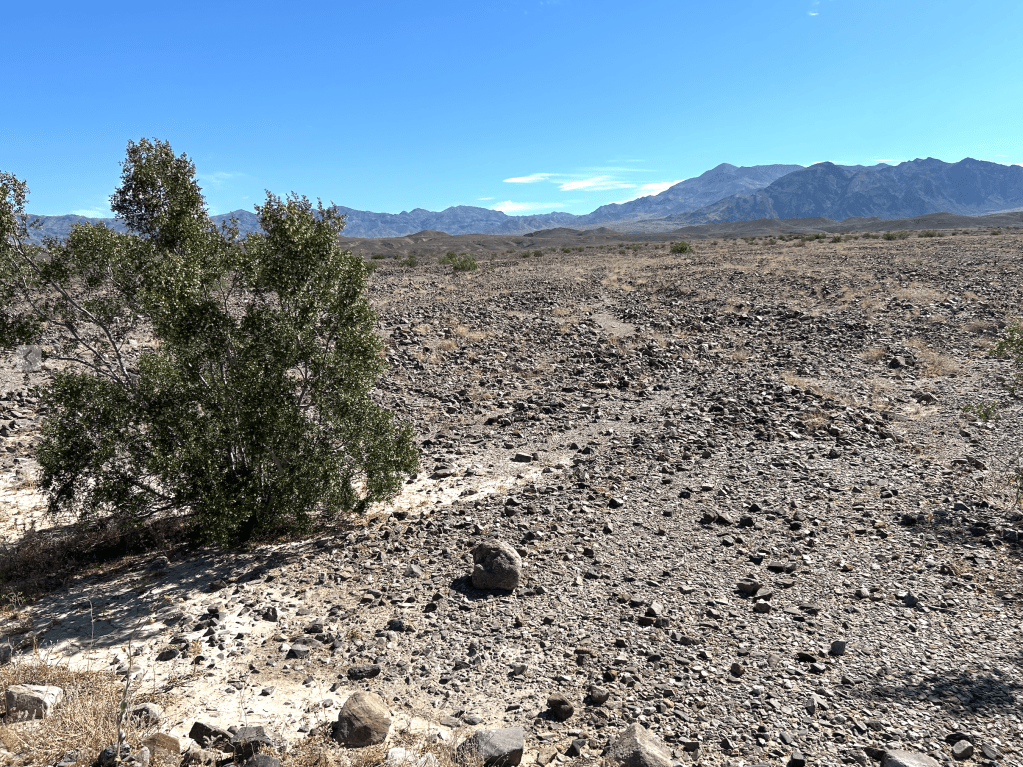
Not much else here, is there?
Of course, a highlight of Death Valley is its exotic and colorful rock structures. Think of a cross between the Badlands and Utah’s red rock marvels.
The bottom of the valley is one massive salt flats basin – a residue from a previous large lake. The surface of the basin is 282 feet below sea level – the lowest level in the US. It is a little weird to experience the largest elevation contrast in the US (from the basin up to a visible Mount Whitney peak at 14,500 feet) while simultaneously experiencing an extreme temperature contrast, sitting in 104 degrees and looking at still abundant snow fields on the mountain.
We’re not sure when we will get back to Death Valley, but we are glad we went. Hopefully next time we will do it without having to endure a FUBAR day.
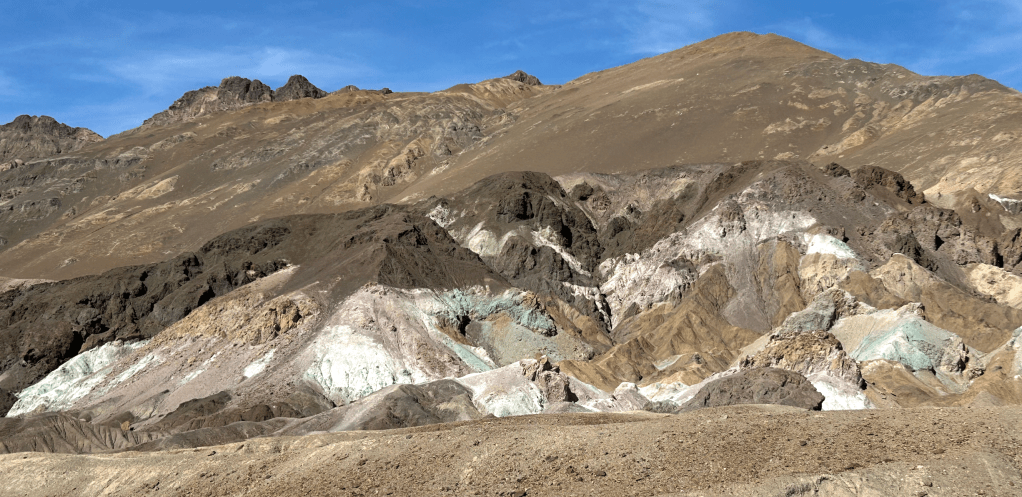
The “Artist’s Palette”
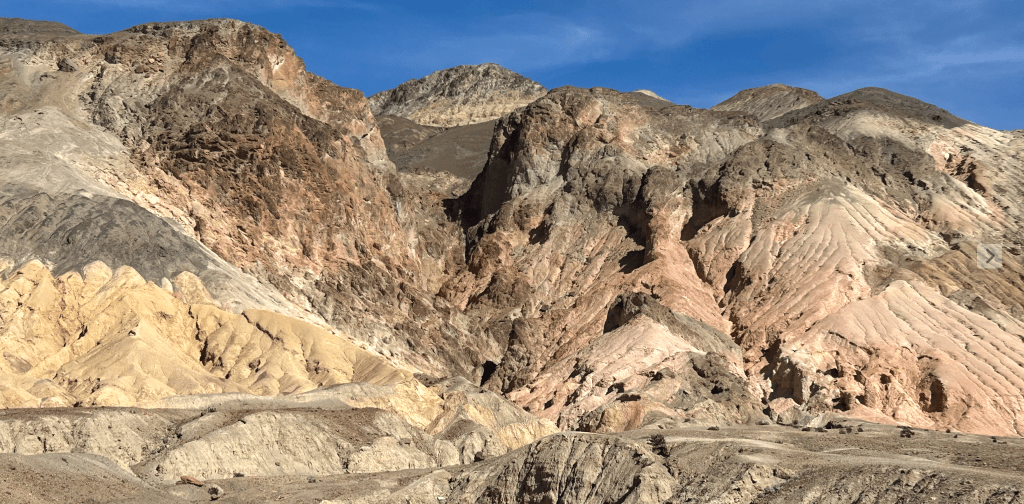
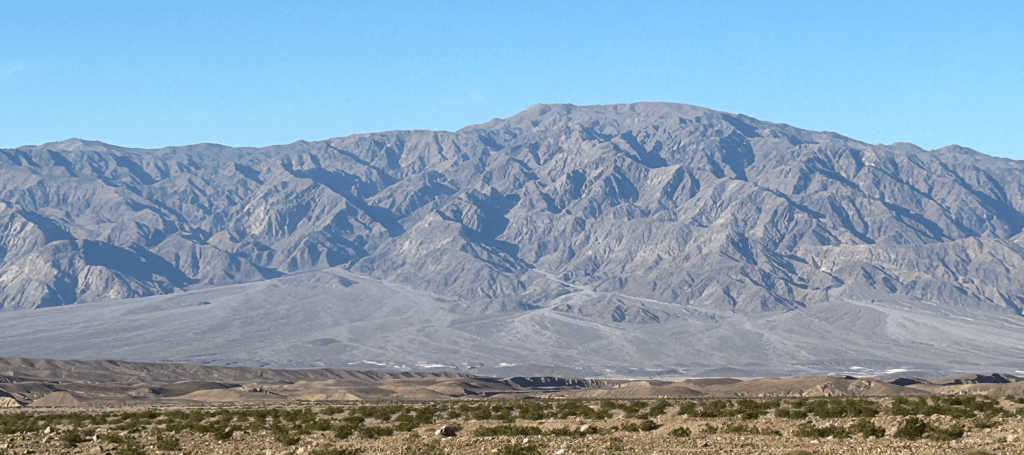
Rivers of soil and rock flowing out of the mountains
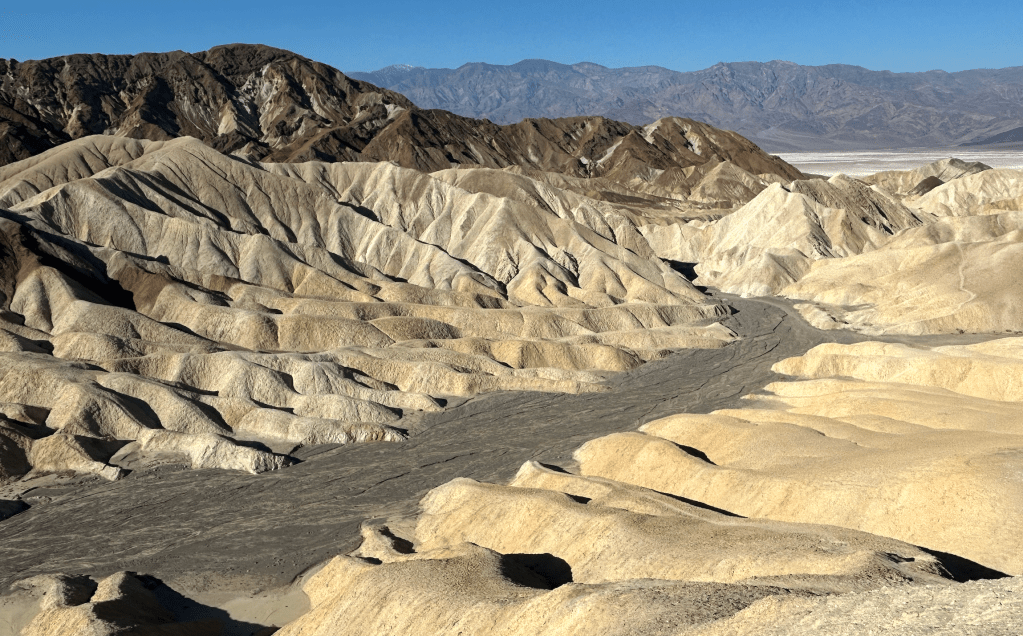
You can’t make this up, right?
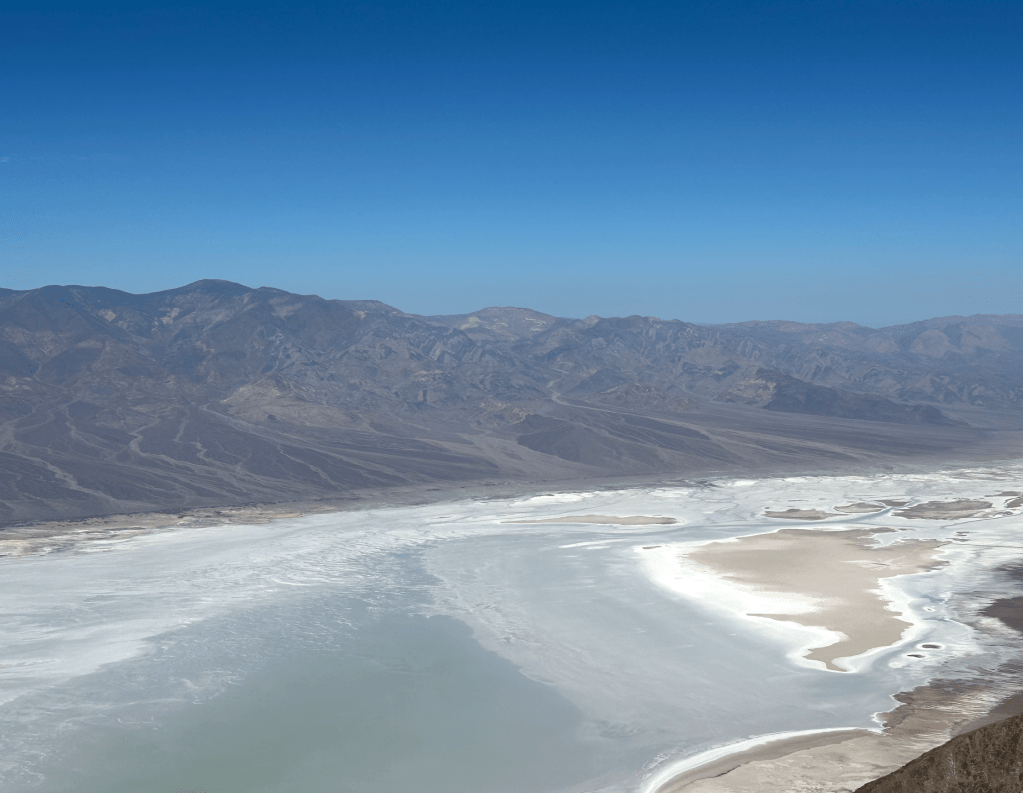
The remnants of a massive lake
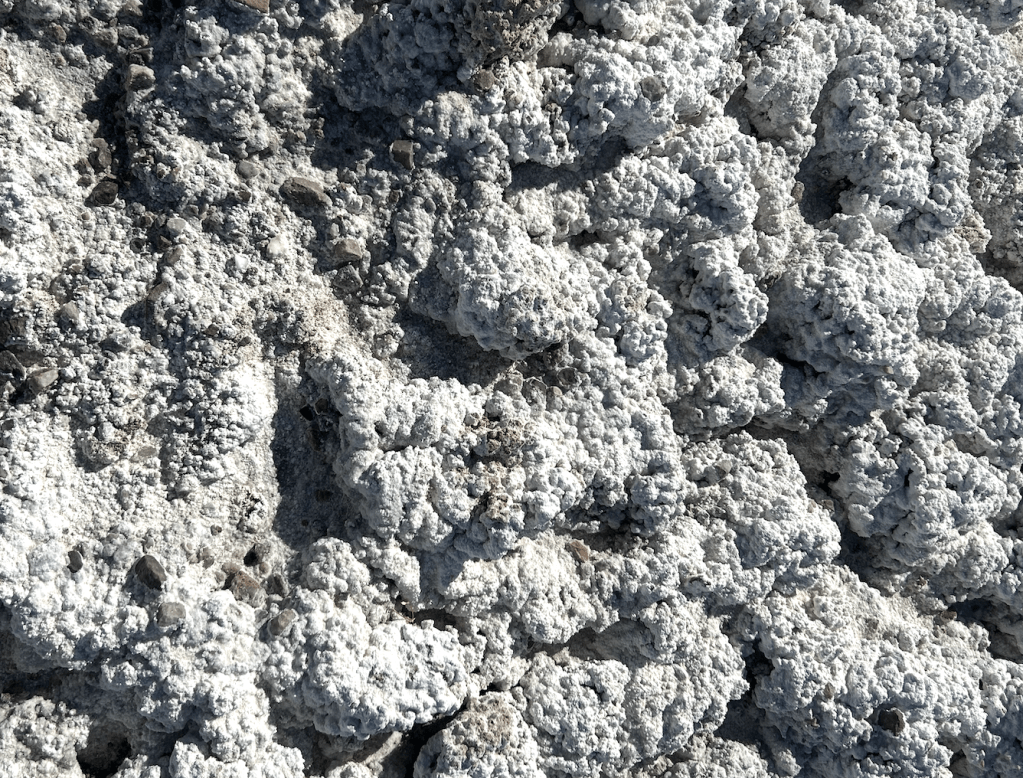
What it looks like up close
A Post-Script on the Central Valley
We intersected with California’s Central Valley at multiple parts of our journey. Each dip into it left us amazed at its scale, its abundance of production, its role in American life and its precarious future in a warming world.
The valley is roughly 450 miles long and 40-60 miles wide, stretching from Redding in the north to Bakersfield in the sound, (where we took our on-the-road lunch repast).
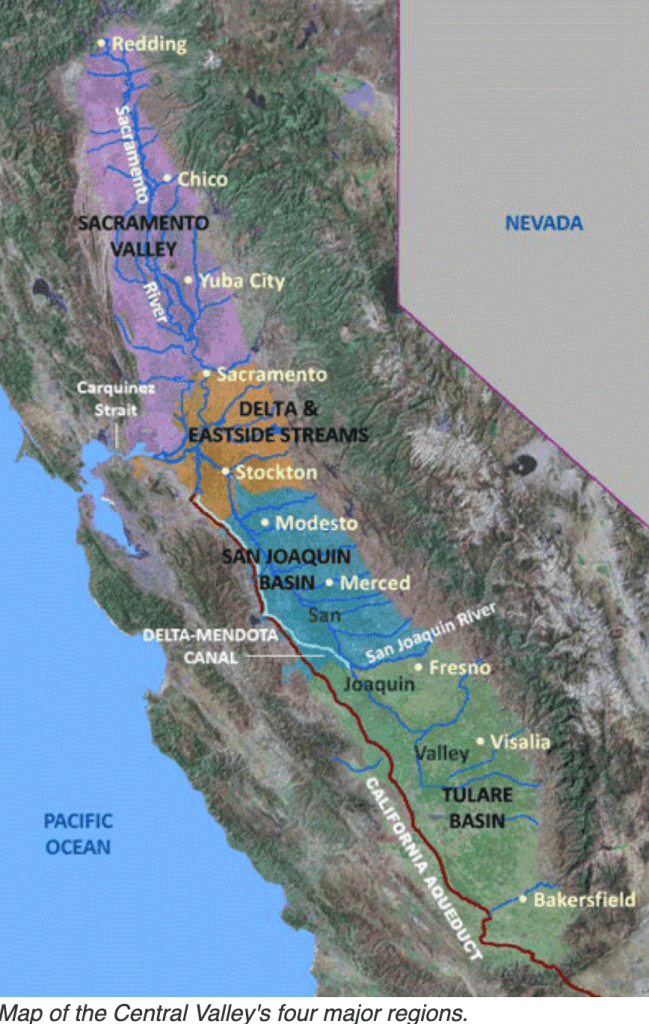
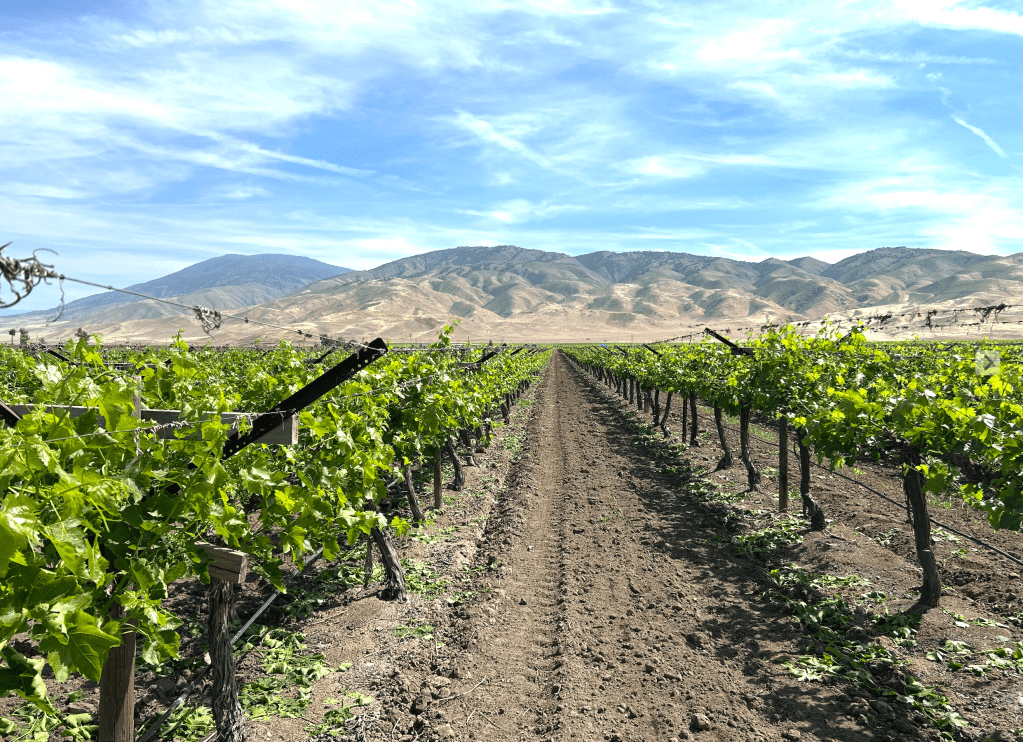
One glimpse into its vastness –– table grapes as far as the eye can see
The valley includes 7 million acres of farmland, about two-thirds of all California cropland. It is only 1% of US farmland, but produces 25% of the nation’s food supply, and about 40% of our fruits, nuts and table foods. While it produces over 250 different types of produce, the core set includes, in order of value:
- Almonds (CA produces 100% of the country’s almonds)
- Pistachios
- Grapes (wine + table)
- Dairy (milk)
- Tomatoes (processing)
- Citrus (oranges, lemons)
- Lettuce & leafy greens
- Rice (mainly Sacramento Valley)
- Cotton
- Hay/alfalfa
The Central Valley, of course, faces tough water challenges and choices. Agriculture uses 80% of California’s water – meaning that the main water challenges is not containing urban development but figuring out how to produce the same amount of food with less water.
Almonds and pistachios are a particular point of water pressure. They cover 2-2.5 million acres of land and account for 20-30% of all CA agricultural water use. No other single crop category comes close in total water consumption. They present an additional challenge because they are “water inflexible”. You can’t put them fallow for a year or two – once you plant them you must water them constantly. So, water demand is fixed, even if market demand is variable. Unfortunately, almond acreage has doubled since 2000. Pistachio acreage has increased even more, although from a lower base.
The Central Valley aquifer is a single, massive sediment-filled groundwater basin that underlies the entire Central Valley. It is one of the largest groundwater reservoirs in the United States and the most important groundwater system for US agriculture, providing more than 50% of California’s groundwater. It is also among the most heavily pumped in the US, resulting in falling water tables, land subsidence and long-term loss of storage capacity as the layers in the aquifer collapse as the water is pumped out. The total volume of the aquifer is estimated at 850 million acre-feet (MAF) with 400 MAF of that being economically usable. Since 1960, an estimated 60 MAF has been lost to pumping, about 15% of the usable total.
The aquifer serves as a “water buffer” in severe drought years, when additional pumping makes up for lost surface water. Drought year drawdowns can amount to 1.5-2% of the total available water, at which rate a single intense drought decade could remove 10-20% of the aquifer’s usable groundwater.
There is some action being taken to try and reverse these depletion scenarios. The 2014 Sustainable Groundwater Management Act (SGMA) requires local agencies to sustainably manage groundwater in high- and medium-priority basins. It mandates forming Groundwater Sustainability Agencies (GSAs) to develop plans (GSPs) to eliminate overdraft and avoid undesirable results (like land subsidence or water quality issues) by 2040 or 2042. As noted in a previous blog, we saw this law at work in the Borrego Springs Groundwater Management Plan.
The valley is estimated to be “over-drafting” the aquifer by ~2 MAF/year. Since irrigated acres use on the order of 2–4 acre-feet/year (depending on crop and place), then eliminating that deficit by land retirement alone would require 500,000 to 1,000,000 acres (15% of the valley total) shifting out of intensive irrigation.
Maybe we should all be eating less almonds and pistachios…
Wishing you all well until we see you next time. And hoping that you don’t have any FUBAR days in the near future — but if you do, remember Bob’s advice: “Tomorrow will be another big puppy day!”
Michelle & John
PS — Our next blog will be from Tamworth, NH. We return on April 13. We will reflect on our trip, what we learned and what it is like to get reintegrated into our old rhythms…and of course, what the prospects are for the next Grand Adventure!
 John and Michelle's Grand Adventure
You must be logged in to post a comment.